Panic Attack on Train Japan: Step-by-Step Help in English
A transport-first guide for foreigners: 7 steps, Japanese phrases, safety buttons, and English hotlines after you get off.
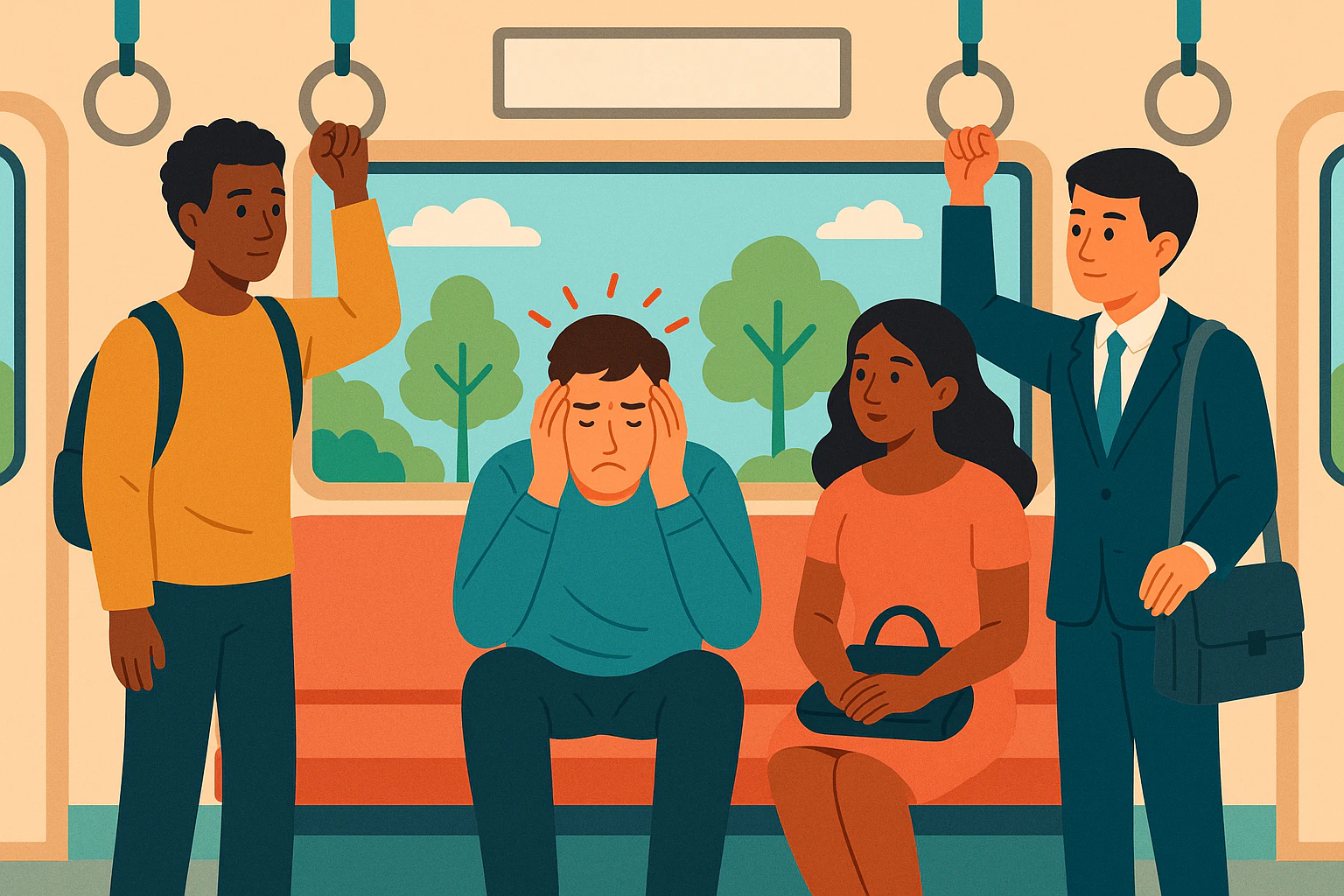
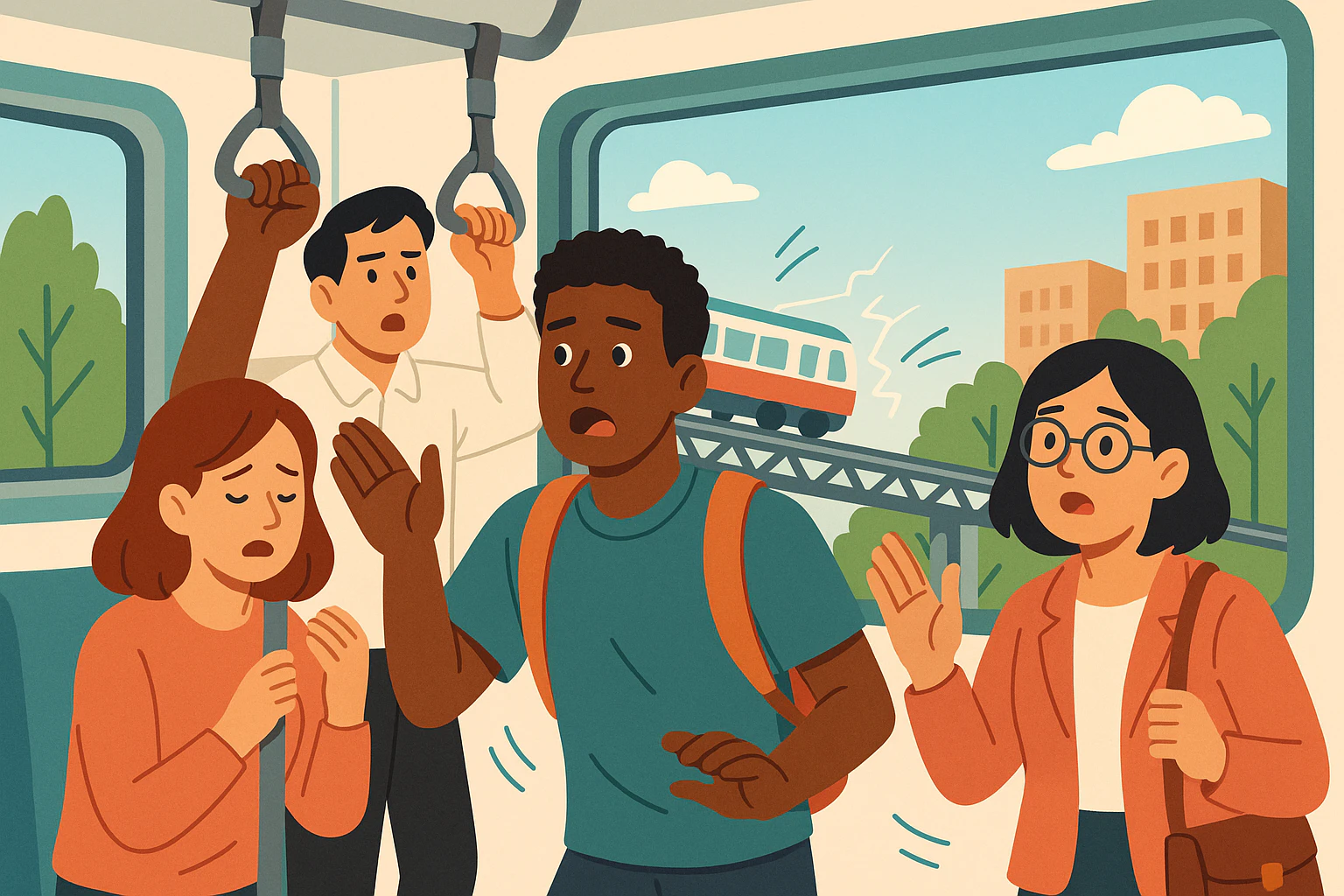
Tokyo at 8:30 a.m., a packed commuter car, and your body suddenly feels like it’s malfunctioning: tight chest, dizziness, racing thoughts, “I have to get out.” If you searched for panic attack on train Japan, you probably don’t want a generic mental-health article—you want to know what to do right now, on a moving train, in a country where you may not feel confident in Japanese.
This guide is transport-first: where to move inside the carriage, what to say (with copy-paste Japanese), which intercoms/buttons exist on trains and platforms, and what multilingual support you can use after you get off. (This is not medical advice; if you think you’re having a medical emergency, treat it as one.)
Why trains trigger anxiety for expats in Japan
Let’s name what makes Japan’s rail commute uniquely tough when you’re foreign, new, or already stressed.
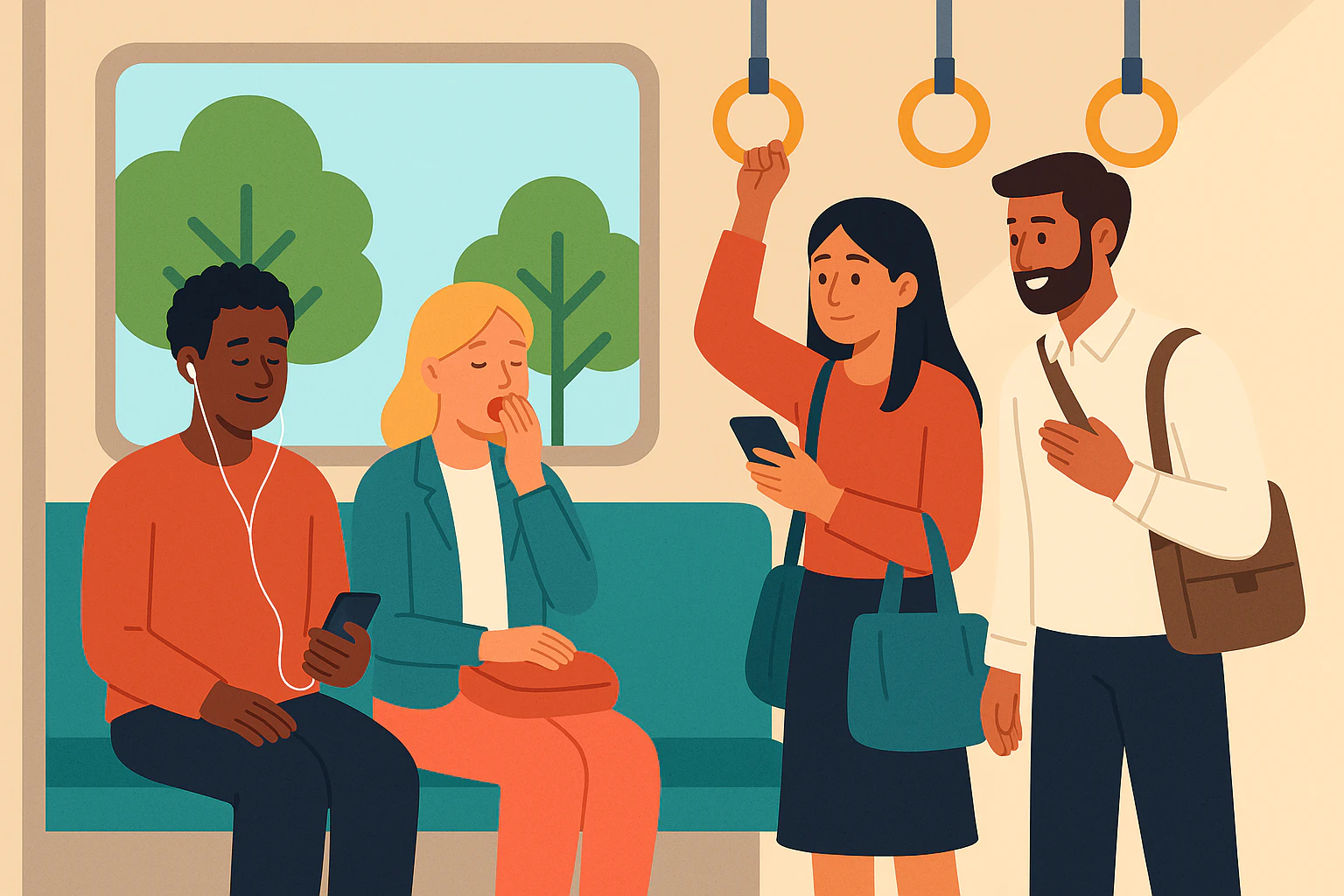
Crowding and sensory overload (especially in big-city rush hour) can trigger a threat response: heat, noise, body contact, and limited personal space. If you already struggle with commuting anxiety Japan, the predictability of “it will be packed” can become its own trigger.
Language and uncertainty amplify panic. Not knowing the exact words for “I’m not okay,” not knowing which button is safe to press, or worrying you’ll cause trouble can keep you stuck in your seat even when you need help.
The “don’t bother others” feeling is real—many foreigners interpret the quiet train culture as “I must handle this alone.” But Japanese railway operators explicitly provide staff-call intercoms on platforms and emergency reporting devices in trains for situations where someone is ill or there’s danger. Using them correctly is not “making trouble”—it’s what they’re for.
If you want a deeper read on the social rules (and how to navigate them without freezing up), see our guide to Japanese train etiquette for foreign residents.
Keep this goal in mind: you don’t have to “win” against panic while trapped in place. Your goal is to create space/air, reduce decision load, and get yourself to the next safe point (usually the next station) where staff can support you.
During a panic attack on a Japan train: a simple 7-step action plan + Japanese phrases
Here’s a practical 7-step plan you can follow even when your brain is foggy. If you can, take a screenshot of the phrases and keep them in your Favorites.
-
Do a 5-second reality check (quietly): “This feels dangerous, but it may be panic.”
Panic symptoms can mimic serious conditions. If you have crushing chest pain, fainting, severe trouble breathing, paralysis/weakness, or you’re unsure, treat it as a medical emergency and ask for help immediately.
-
Change your posture to signal safety to your body: feet planted, knees slightly bent, shoulders down.
If standing, hold a strap/rail with one hand and keep your other hand on your chest or belly to anchor your breathing. If you can sit, sitting reduces fall risk if you get lightheaded.
-
Move to a “better air / easier exit” spot—without forcing through the crowd:
- Best target: near the doors (but not blocking them), so you can step off quickly at the next station.
- Often less intense: the end of the car near the connection between cars (the “gangway” area) can feel less claustrophobic.
- Avoid: pushing deep into the middle of the crowd. It usually increases contact and panic.
If you can’t move, shift your body sideways and create a small “breathing pocket” by turning your shoulders and focusing on a fixed point (like an ad or the route map).
-
Tell someone nearby in one sentence (you don’t need a full explanation):
- Excuse me, I feel unwell. (Sumimasen, kibun ga warui desu.)
- I will get off at the next station. (Tsugi no eki de orimasu.)
- Could I have a little space? (Sukoshi supēsu o itadakemasu ka.)
In many cases, that’s enough for someone to offer a seat or help you reach the door area.
Not sure what’s polite or realistic for your specific line/station/crowd level? Ask a local Japanese person on LO-PAL for personalised advice.
-
Decide: ride to the next station, or contact staff right now?
Ride to the next station if you can stand safely and you’re not at risk of collapsing. Contact staff immediately if you feel you might faint, can’t breathe normally, or you’re alone and overwhelmed.
-
If you need staff: use the train’s emergency notification device (not the door-release equipment).
Tokyo Metro instructs passengers to use emergency notification devices inside the train to contact crew when someone is seriously ill or there is a fire. You can also contact staff via platform intercoms on the station platform. (Tokyo Metro’s English “What to do if…” emergency response page summarizes these tools.) Tokyo Metro: Emergency response (“What to do if…”)
- Help sentence to say: I have symptoms like a panic attack. (Panikku hossa no yō na shōjō ga arimasu.)
- Simple alternative: It’s hard to breathe. (Iki ga kurushii desu.)
-
When the doors open: step off, then step aside—don’t stop in the flow.
On the platform, move away from the door line, find a wall/pillar (without leaning over the edge), and lower your gaze. Then decide your next small action: sit, drink water, message a friend, or speak to station staff.
Copy-paste message to show station staff (works when your speaking shuts down):
Excuse me. I’m feeling unwell. I may be having a panic attack. I’d like to rest in a quiet place. Please tell me if I need an ambulance.
(Sumimasen. Taichō ga warui desu. Panikku hossa kamo shiremasen. Sukoshi shizuka na basho de yasumitai desu. Kyūkyū ga hitsuyō nara oshiete kudasai.)
Japan-specific safety tools on trains and platforms (Tokyo Metro/JR examples) and what NOT to press
Japan’s trains are full of safety equipment, but the labels can be confusing when you’re panicking. Here’s what to look for and what to avoid.
1) Platform intercoms to call staff (good for “I’m unwell” situations)
Tokyo Metro explains that intercoms on the platform allow you to contact station staff—for example, if you drop something on the tracks or see something suspicious. Tokyo Metro: platform intercoms and in-train emergency devices
On Tokyo Metro’s Japanese safety pages, this is described as station staff-call intercom (駅係員よびだしインターホン), and Tokyo Metro notes these are installed on station platforms. Tokyo Metro: Station & in-car safety measures (Japanese)
If you’re looking for the sub-keyword specifically: this is the kind of Tokyo Metro emergency intercom you want when you need staff support but there’s no life-threatening danger.
2) Emergency notification device inside the train (use this before anything involving doors)
Tokyo Metro describes an in-train device (非常通報装置) that lets you notify staff and talk to them directly; Tokyo Metro’s guidance says to press the button immediately in an emergency and speak once the lamp lights. Tokyo Metro: Emergency notification device (非常通報装置)
Other operators have similar equipment. For example, the Tokyo Metropolitan Bureau of Transportation (Toei Subway) disaster-preparedness page shows an in-car intercom/emergency reporting device (インターホン/非常通報器) used to speak with crew.
3) Platform emergency stop button (only for immediate danger on/near the tracks)
Tokyo Metro’s emergency guidance says that if someone falls from the platform onto the tracks, you should push the emergency stop button located on the platform to stop trains. Tokyo Metro: “If someone falls from the platform…”
JR East also publishes a safety page explaining the flow after pressing an emergency stop button (非常停止ボタン) and how staff respond. JR East: Emergency response (非常停止ボタン)
What NOT to do: don’t press the platform emergency stop button just because you feel panicky and want the train to stop. Use the in-train emergency notification device or get off at the next station and use the platform intercom to call staff.
4) Emergency door equipment (do not touch unless instructed)
Tokyo Metro’s safety page explains an emergency door cock (非常用ドアコック) that allows doors to be opened manually in an emergency, and it explicitly warns: do not operate it while the train is moving and follow staff instructions because track evacuation is extremely dangerous. Tokyo Metro also warns that unnecessary operation may be punishable under 鉄道営業法第33条. Tokyo Metro: Emergency door cock warnings (非常用ドアコック)
Translation in plain English: even if you feel trapped, opening doors or trying to self-evacuate onto the tracks can create a much bigger emergency. Use the emergency notification device first, and wait for crew instructions.
5) Why labels look different (and why that helps you)
After MLIT published a guideline in June 2022 about clearer in-car emergency equipment displays, Tokyo Metro announced it would strengthen guidance videos and unify/standardize pictogram-style labeling across its cars and platform doors. Tokyo Metro news release on strengthening emergency equipment guidance (2022-08-15)
Tokyo Metro’s safety page also describes placing stickers that clearly show where emergency equipment is located, referencing the MLIT guideline on in-car emergency equipment display. Tokyo Metro: in-car emergency equipment location stickers
Rule of thumb: If your problem is “I’m unwell / I need staff,” use the intercom/emergency notification device. If the problem is “someone is on the tracks / immediate collision risk,” use the platform emergency stop button. Avoid door/track evacuation equipment unless staff instructs you to use it.
After you get off: English & multilingual help (Tokyo vs other regions) + when to call 119/110
Once you’re off the train, your nervous system usually settles faster. Now the goal is (1) ensure you’re medically safe, (2) get immediate emotional support if needed, and (3) reduce the chance of repeat episodes by adjusting your commute plan.
First: decide whether this is an emergency
Call 119 (ambulance/fire) if there’s severe breathing trouble, fainting, injuries, chest pain you can’t explain, or you’re not sure it’s “just panic.” If you are in immediate danger from yourself or others, TELL also advises calling 110 (police) or 119 and staying on the line. TELL Lifeline hours page (includes emergency guidance)
If the situation isn’t a crime/accident emergency but you need police advice (stalking, DV, scams, etc.), Tokyo Metropolitan Police lists #9110 (within Tokyo) and 03-3501-0110 for its General Advisory Center, with support available in Japanese, English, Chinese, and Korean. Tokyo Metropolitan Police: Help hotline information (#9110 / 03-3501-0110)
English mental health hotlines (nationwide)
If you need someone to talk to soon—especially if you’re alone—these are the most practical “save in your phone” options. (Hours can change, so always confirm on the official pages.)
-
TELL Lifeline (English support): TELL publishes current phone and chat hours plus numbers, including toll-free 0800-300-8355 and 03-5774-0992. Their page also shows late-night chat availability on weekends. TELL: Lifeline phone & chat hours
-
Yorisoi Hotline (よりそいホットライン): Japan’s Ministry of Health, Labour and Welfare “Mamoru yo Kokoro” page lists Yorisoi Hotline 0120-279-338 and an IP-phone number 050-3655-0279, noting foreign-language options via guidance. MHLW: Mamoru yo Kokoro (hotline list)
For the foreign-language line specifically, the operator (Social Inclusion Support Center) instructs callers to press 2 after the initial guidance and publishes the weekly schedule on its English page. Yorisoi Hotline (operator): foreign-language line instructions & hours
If you’d like a fuller, regularly updated list (including counseling/clinics), see our dedicated guide: Mental health support for foreigners in Japan (2026 guide).
Tokyo-specific support (practical life stressors that worsen panic)
Sometimes the “panic on the train” is the last straw on top of bank account problems, phone contract stress, work pressure, or isolation. Tokyo has a strong general consultation option:
-
Tokyo Multilingual Consultation Navi (TMC Navi): Tokyo Metropolitan Government announced the service is available free via toll-free 0120-142-142, weekdays 10:00–16:00, in 15 languages. Tokyo Metropolitan Government: TMC Navi now toll-free
And if you live in Tokyo, some wards explicitly mention interpreter support tools for consultations. For example, Setagaya Ward notes foreign-language support can be handled using tablets for its mental health consultation listing and related services. Setagaya Ward: foreign resident consultation windows (includes mental health consultation note) / Setagaya Ward: tablet interpretation counters
Outside Tokyo: how to find multilingual consultation windows
Support varies widely by prefecture and city, so the fastest approach is to use a national directory and then check your nearest international association/municipal counter.
-
CLAIR directory (nationwide): CLAIR’s Multicultural Coexistence Portal publishes a nationwide list of foreign resident consultation offices (with an Excel file), noted as updated as of April 2024. CLAIR: Nationwide consultation offices
-
Example (Shizuoka / Hamamatsu): Hamamatsu’s multicultural portal lists mental health consultations for foreign residents with interpretation (English, Filipino, Vietnamese, Indonesian, Chinese, Spanish) and provides the contact number 053-458-2170 (Hamamatsu International Association / HICE). HAMAPO/HICE: Mental health consultation for foreigners (Hamamatsu)
Mini “recovery plan” for the next commute
Once you’re stable, plan one small change before your next ride. Reducing uncertainty is a powerful antidote to panic.
- Choose a lower-stress time: even 20–30 minutes earlier/later can change crowding dramatically.
- Pick a “safe car” in advance: for example, ride near the first/last car if it’s usually less packed at your station, and stand near a door for easy exit.
- Pre-write your help sentence (in Notes) so you can show it instead of speaking.
- Practice the station-staff interaction once when you’re calm: where the station office is, what the intercom looks like, and what you’ll say.
FAQ
These are the most common “in the moment” questions we hear from foreign residents.
Should I press the emergency stop button if I’m panicking?
Usually no. Tokyo Metro’s guidance describes the platform emergency stop button for situations like someone falling onto the tracks, where trains must be stopped immediately. If you are unwell, it’s typically better to use the in-train emergency notification device or get off at the next station and contact staff via an intercom. Tokyo Metro: emergency response guidance
Is it okay to use the in-train emergency notification device for a panic episode?
If you might faint, can’t breathe normally, are alone, or you’re not sure whether it’s a medical emergency, it’s appropriate to contact staff. Tokyo Metro describes using in-train emergency notification devices when a passenger is seriously ill or there is a fire. Tokyo Metro: in-train emergency notification devices
What if I can’t speak Japanese while panicking?
Show a pre-written message (like the one above), or use a single sentence: “I feel unwell.” Station staff are used to helping sick passengers, and simple language is enough to start.
What’s the fastest English help line I can call after I get off?
TELL publishes its current Lifeline phone numbers (including 0800-300-8355) and chat hours on its official site. Yorisoi Hotline also provides foreign-language support by pressing 2 after the guidance, with hours listed by the operator. TELL: hours & numbers / Yorisoi Hotline: foreign-language line details
Related Articles
- Mental health support for foreigners in Japan (2026 guide)
- Japanese train etiquette for foreign residents: unwritten rules
- Disaster medical preparedness in Japan: meds, 119, and insurance basics
Need More Help? Ask on LO-PAL
If you want to prevent a repeat episode, the most effective next step is to make your commute predictable: a less crowded route, a safer transfer plan, and a script you can use even when your brain blanks.
That’s exactly what we built LO-PAL for. On LO-PAL, you can post a question or request and get matched with local Japanese helpers who can help you plan a lower-stress commute route, identify where the staff-call intercoms are at your station, and practice the exact Japanese phrases you’ll need for your line and neighborhood.
If you want to know more about this topic or need specific local information, ask a local Japanese person on LO-PAL.
Written by

Founder, LO-PAL
Former Medical Coordinator for Foreign Patients (Ministry of Health programme) and legal affairs professional. Built LO-PAL from firsthand experience navigating life abroad.
Written with partial AI assistance
Read full bio →