Japan Disaster Alerts in English: Apps, Hazard Maps, Shelters
A 1-hour setup to get Japan disaster alerts in English, save hazard maps, and find your nearest shelter before a quake/typhoon.
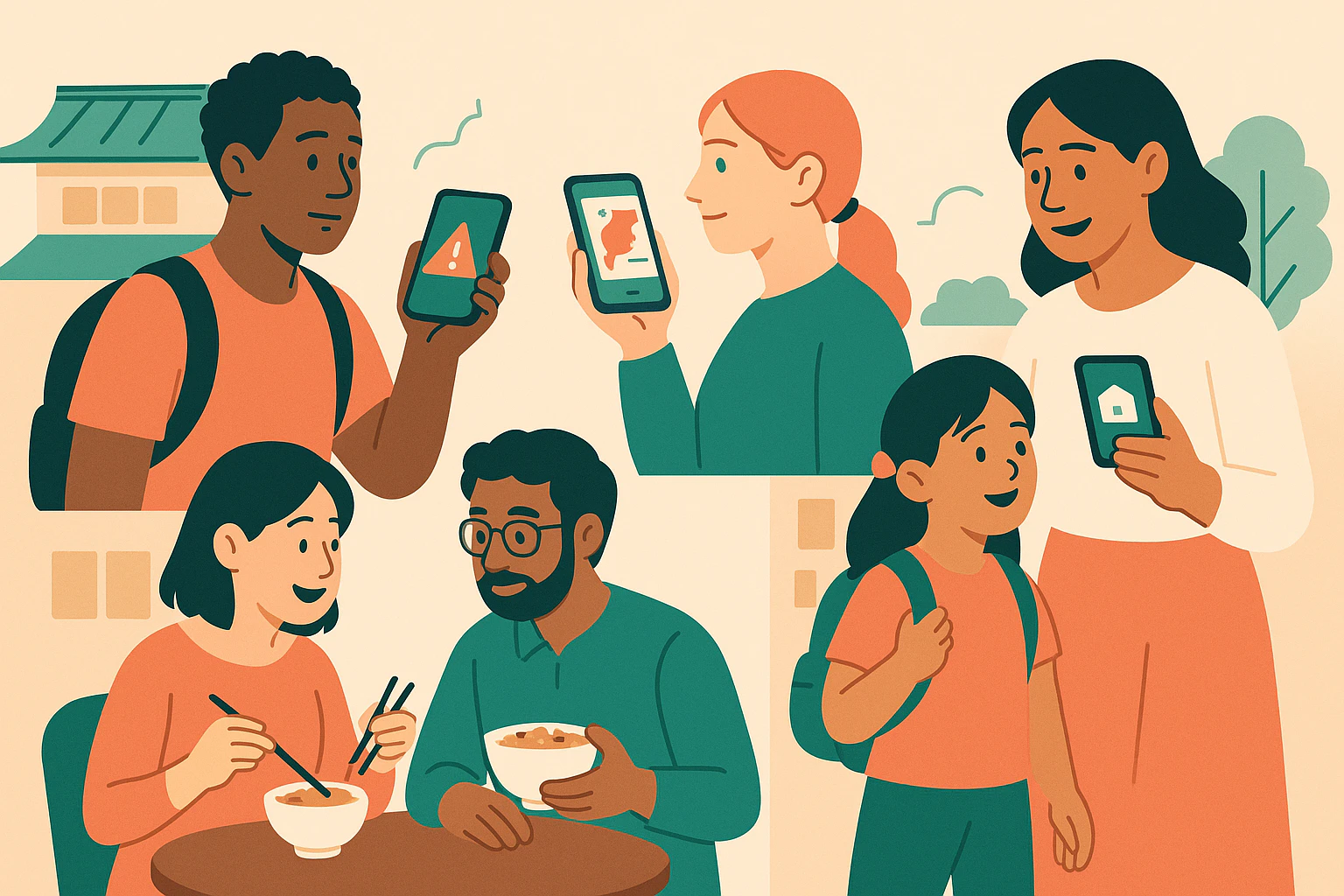
Most emergency guides for Japan start with generic “what to pack.” That’s important—but as a foreign resident or visitor, the hardest part is often the first 10 minutes: getting Japan disaster alerts in English (or at least in a language you can act on) and knowing exactly where to evacuate in your own neighborhood.
This article is a practical, 1-hour “phone + map setup” playbook. You’ll install a few English-friendly alert sources, save a Japan hazard map in English (or an English-accessible alternative), and pin your nearest Japan evacuation shelter for foreigners—with Tokyo vs regional examples.
Your goal: In a quake or typhoon, you should be able to answer these in under 60 seconds: (1) What is happening? (2) Is my area in danger? (3) Where is my nearest evacuation site/shelter? (4) What’s my next action?
Japan disaster alerts in English: What alerts exist in Japan (and why foreigners miss them)
Japan’s alert system is layered: national agencies issue warnings, municipalities issue evacuation instructions, and your phone/carriers may push emergency broadcasts. Foreigners often miss alerts because they’re split across multiple sources, some arrive in Japanese only, and evacuation information is local (city/ward) and location-specific.
Here are the key alert types you’ll see, and what they typically mean in real life.
1) Earthquake & tsunami alerts (fast, seconds to minutes)
Earthquake Early Warning (EEW) can arrive seconds before strong shaking. You may get a loud system alert on your phone, a TV/radio interrupt, and app notifications.
Tsunami warnings/advisories are critical for coastal areas—if you’re near the ocean and receive a tsunami warning, the safest move is usually to head to higher ground immediately and confirm official updates afterward.
2) Weather warnings, “special warnings,” and the 5-level evacuation concept (slower, hours to days)
For typhoons and heavy rain, Japan uses a combination of meteorological information (issued nationally) and evacuation information (issued by your municipality). The Japan Meteorological Agency (JMA) also operates a Multilingual Information on Disaster Mitigation portal where you can view weather + earthquake/tsunami/volcano information in multiple languages.
Municipal evacuation info is commonly communicated using Alert Levels 1–5. A practical rule used in many official guides: do not wait for Alert Level 5; if your area is at risk, evacuate by Alert Level 4.
3) Local municipal alerts (the ones that decide “where you go”)
Even if national alerts are multilingual, your evacuation destination is determined locally. Cities/wards often publish evacuation sites, shelters, and hazard maps separately—and they may push them via local apps, emails, websites, community loudspeakers, or systems connected to J-Alert/L-Alert.
This is why two people in the same prefecture can get very different instructions, and why foreign residents in regional areas sometimes struggle more than people in central Tokyo.
Why foreigners miss them (common reasons)
- Notifications disabled (especially travel mode / do-not-disturb / battery optimization).
- System alerts arrive, but in Japanese (or in wording that’s hard to act on quickly).
- “Evacuation site” vs “evacuation shelter” confusion (different places may open depending on the disaster).
- You have national apps, but not your city’s map (so you know “a warning exists,” but not “where to go”).
- You moved recently and never rechecked your local hazard map and shelter list.
1-hour setup for Japan disaster alerts in English: install + bookmark this list
Set a timer for 60 minutes and do this once. After you finish, you’ll be able to receive Japan disaster alerts in English (or multilingual equivalents) and you’ll have backup sources if one system fails.
Step 1 (10 minutes): Turn on phone-level emergency alerts (don’t rely on apps only)
If you use an iPhone, Apple provides Japan-specific instructions for receiving earthquake/tsunami and other emergency alerts. Alerts are supported with a compatible SIM/eSIM, and Apple notes that alerts can be translated into the language set on your device.
- Open Settings → Notifications
- Scroll to the bottom → Emergency Alerts
- Turn alerts ON (as available on your device)
Reference: Apple Support – Set up emergency alerts for Japan on iPhone.
If you use Android, menus vary by manufacturer and carrier. As a general rule, search your Settings for “emergency alerts” or “wireless emergency alerts”, and ensure they are enabled.
Step 2 (15 minutes): Install the official “Safety tips” (Japan disaster app in English)
If you install only one nationwide tool, make it Safety tips. It’s a disaster information delivery app for foreign travelers that is supervised by the Japan Tourism Agency, and the official government page notes it can send push notifications for Emergency Earthquake Alerts, tsunami warnings, special weather warnings, and evacuation information.
The same official page (last updated October 10, 2025) states Safety tips supports 15 languages, includes action flowcharts and communication cards, and provides an API that other services can use.
- Official overview page: Japan Tourism Agency / MLIT – Disaster tools for inbound travelers
Setup checklist inside Safety tips:
- Allow location access (so alerts match where you are right now).
- Allow notifications (lock screen + sound).
- Open the app once and find the useful links section so you know where it lives before a real emergency.
- Check the communication cards so you can point-and-show if you can’t speak Japanese.
Step 3 (10 minutes): Bookmark the JMA multilingual portal (your “official detail view”)
Apps are great for push alerts. But when you need details (what exactly is issued, where, and what changed), use the official JMA multilingual portal and keep it on your home screen.
- JMA – Multilingual Information on Disaster Mitigation (weather + earthquake/tsunami/volcano in many languages)
Tip: Add it to your home screen as a shortcut so you can open it like an app.
Step 4 (10 minutes): Add a “news + broadcast” backup in English (NHK WORLD-JAPAN)
During major disasters, live broadcasts and frequent updates help you understand what’s happening across Japan (transport, aftershocks, evacuation guidance). Keep at least one English-first broadcast source installed and pinned.
- NHK WORLD-JAPAN (website/app)
Some municipalities also note that NHK may provide multilingual emergency broadcasts for tsunami situations on specific channels/secondary audio (availability depends on the broadcast and situation). For example, Chuo City in Tokyo describes multilingual emergency broadcasts during predicted tsunamis.
Step 5 (10 minutes): Save the most useful hotline numbers (Japan-wide + local examples)
When you’re stressed, you won’t search well. Save these into your contacts as “Emergency – Japan” so they appear at the top.
- Police: 110
- Ambulance / Fire: 119
For visitors and short-term travelers, Japan’s official inbound safety page lists the Japan Visitor Hotline (JNTO), which offers 24-hour support in multiple languages and includes disaster assistance. The number listed is 050-3816-2787.
Local model to copy: Miyazaki City publishes a Multilingual Disaster Support Call Center that opens only during active disasters/alerts. It lists a toll-free number 0800-222-5103 and support for 21 languages.
Your action: Search your own city’s website for “multilingual disaster call center,” “災害 多言語 コールセンター,” or your prefecture’s international association. Many areas have support that activates only when a disaster happens.
60-minute checkpoint: If you can (1) receive a push alert (Safety tips), (2) open official details (JMA multilingual), and (3) view your local map (next section), you’re already ahead of most people.
Japan disaster alerts in English need a map: find your evacuation shelter + hazard map (Tokyo vs other cities)
Getting alerts is only half the job. The other half is instantly seeing: “Am I in a flood/landslide/tsunami zone?” and “Which shelter should I go to?” This is where a Japan hazard map in English (or English-accessible) matters.
First, learn the two words you’ll see everywhere
Municipalities often separate places by purpose. Even if English labels vary, you’ll frequently see:
- 避難場所 (hinan-basho): an evacuation place/site (often open area for immediate danger)
- 避難所 (hinan-jo): an evacuation shelter (a facility like a school gym that may open for longer stays)
In many disasters, you may first move to immediate safety, then later relocate to a shelter depending on municipal instructions.
Tokyo example: use the official Tokyo Disaster Prevention App (“Disaster Preparedness Tokyo”)
Tokyo has one of the most foreigner-friendly setups. The official Tokyo Disaster Prevention App supports multiple languages (including English, Chinese, Korean, and “Easy Japanese”) and includes a powerful disaster prevention map.
Tokyo’s official feature list includes the ability to switch map views (such as online maps, water hazard risk maps, and local risk maps) and to download offline maps for use when networks are unstable. It also lists “latest disaster information” categories such as evacuation info, earthquake/tsunami, weather warnings/advisories, and more.
- Tokyo Metropolitan Government – Tokyo Disaster Prevention App (overview)
- Tokyo Metropolitan Government – Main functions (includes “disaster prevention map” + offline map)
Tokyo setup (15 minutes):
- Install the Tokyo app and switch the language to English.
- Open Disaster Prevention Map and locate your home/work/school.
- Download the offline map for your relevant area(s).
- Pin your nearest evacuation site/shelter and practice the walking route once on a normal day.
Tokyo also provides digital disaster readiness content, including renewed/expanded electronic versions of readiness guides for broader accessibility and multilingual availability.
Tokyo micro-example (wards/cities): local emails and local maps can be multilingual too
Even inside Tokyo, the best shelter information is often ward/city-specific. Some wards offer multilingual “safe and secure” emails for disaster info. For example, Chuo City provides multilingual registration emails and lists the English registration address publicly.
Many Tokyo municipalities also publish English hazard map booklets and web maps. Inagi City, for instance, provides an English “Disaster Prevention Map” page with hazard map downloads and a web version.
Regional example: Sendai’s multilingual hazard map app (a different tool from national apps)
Outside Tokyo, many cities run separate tools that foreigners never hear about. Sendai City announced it began operating a “Multilingual Hazard Map App” using the Uni-Voice Blind app, offering multilingual display and text-to-speech for hazard and evacuation information.
Sendai notes the tool helps users check disaster risk information and evacuation sites, and that it supports multiple languages such as English, Chinese, Korean, Vietnamese, and Nepali (and others listed by the city).
Another regional example: Mie Prefecture’s “Mie Bousai Navi” (8 languages)
Some prefectures publish their own official apps designed for daily residents. Mie Prefecture launched Mie Bousai Navi, stating it supports eight languages and can help users check evacuation sites and hazard information around their current location.
This is a good pattern to remember: national app + prefecture app + city/ward map is often the best combo.
If your city has no English hazard map: use national map portals (and translate)
When you can’t find a clean “Japan hazard map in English” for your exact neighborhood, use a national portal and translate the interface. One widely used option is the Hazard Map Portal / overlay hazard map service (commonly linked by municipal multilingual guides).
For flood-specific planning, the Geospatial Information Authority of Japan provides an English interface for a flood simulation search system that can help you visualize potential flood impacts at an arbitrary point.
Map rule: Save at least one map you can open even if Japanese is hard. Browser translation is fine—what matters is knowing which streets and which facilities are safe for the specific hazard.
Your personal plan for Japan disaster alerts in English: earthquakes, typhoons, and how a local can help
Once your alerts and maps are set, you need a simple plan you can execute under stress. Keep it short: what you do immediately, what you do next, and what you do if you can’t understand the language around you.
Earthquake plan (first 10 minutes)
1) Protect yourself first. Your first decision is not “evacuate” but “survive the shaking.” Move away from falling objects, protect your head, and don’t rush outside during strong shaking.
2) Check tsunami risk if you’re coastal. If you’re near the sea and receive tsunami warnings, prioritize moving to higher ground and follow official instructions rather than waiting to “confirm.” Use Safety tips + JMA + local announcements.
3) Decide: stay put vs evacuate. In many urban earthquakes, staying where you are (if the building is safe) can be safer than moving through glass and debris. Evacuate if your building is damaged, there’s fire risk, or officials instruct evacuation for your area.
Typhoon / heavy rain plan (the “timeline” disaster)
Typhoons and heavy rain usually give you time—if you act early. Use that time to confirm your hazard map, charge devices, secure water/food, and decide your evacuation destination before conditions worsen.
Japan’s 5-level evacuation concept is designed to make timing clearer: many official guides emphasize evacuating by Alert Level 4 in dangerous areas and not waiting for Alert Level 5. You can review a traveler-oriented explanation on the Safety tips site that references Cabinet Office guidance.
Important upcoming update (late May 2026): weather warning information is being redesigned
The JMA has published a special site explaining that a new disaster-prevention meteorological information system is planned to begin in late May 2026 (planned), aligning information for river flooding, heavy rain, landslides, and storm surges with the 5-level evacuation concept to make decisions easier.
What to do now: Don’t memorize old terminology only. Build your habit around the level and action (prepare → assist-evacuate → everyone evacuates → immediate life safety) so you stay resilient as names and formats change.
What to expect at shelters (and how multilingual support works)
Multilingual support varies widely by municipality, but there are standard tools used across Japan. The Shimane International Center explains that CLAIR produced tools for creating multilingual signs and information for emergency shelters, and notes these tools should be trialed before a disaster because they’re hard to use for the first time during a crisis.
Practically, this means you may see pictograms, translated sheets, and multilingual registration/help processes—especially in larger shelters and cities with more foreign residents.
Communication + charging at shelters (system update since Oct 22, 2025)
One very practical improvement: Japan’s major telecom companies announced a standardized framework (starting October 22, 2025) for evacuation shelter support, including sharing which shelters have communication and device charging services and posting contact information for each provider’s services.
Action: Even with better shelter support, assume power may be limited. Keep a charged power bank, and download offline maps in advance (Tokyo app and some local apps support this).
“A local can help” checklist (save this before the next quake/typhoon)
This is where foreign residents gain a huge advantage by preparing a human network, not just apps. Ask a Japanese neighbor, coworker, or community volunteer these questions and save the answers:
- Which shelter is actually used for our block (earthquake vs flood/landslide)?
- Which river/steep slope is the real danger point nearby?
- Where do ward/city alerts appear first (app, email list, loudspeaker, website)?
- What does our building management recommend (elevators, gas shutoff, assembly point)?
- What’s the best walking route that avoids bridges, underpasses, and narrow alleys?
Personal plan shortcut: Earthquake = “protect → check tsunami/fire → decide stay/evacuate.” Typhoon = “confirm map → decide early → move by Level 4 if at risk.”
Need more help? Ask on LO-PAL
If you want to go beyond generic advice and set up Japan disaster alerts in English for your exact neighborhood—ask a local Japanese person who knows your city’s real evacuation rules and shelter locations.
On LO-PAL, foreign residents and travelers in Japan can post questions or request help, and local Japanese helpers respond. Because LO-PAL supports multiple languages (including English, Chinese, Vietnamese, Portuguese, Korean, Nepali, Tagalog, Indonesian, and Spanish), you can ask things like:
- “Which evacuation shelter should I use for floods vs earthquakes near my address?”
- “Can you help me find my city’s hazard map and explain the risky zones?”
- “Can you show me how to register for my ward’s disaster email alerts?”
- “Can you help me prepare a simple Japanese message for my building group chat?”
Next step: Post your city/ward name and nearest station on LO-PAL, and we’ll help you build a local-ready plan before the next quake or typhoon.
Written by

Founder, LO-PAL
Former Medical Coordinator for Foreign Patients (Ministry of Health programme) and legal affairs professional. Built LO-PAL from firsthand experience navigating life abroad.
Written with partial AI assistance
Read full bio →