How to Cap a Huge Hospital Bill in Japan Before You Pay
Urgent playbook for foreign residents in Japan: cap a huge hospital bill upfront with My Number or recover overpayment later.

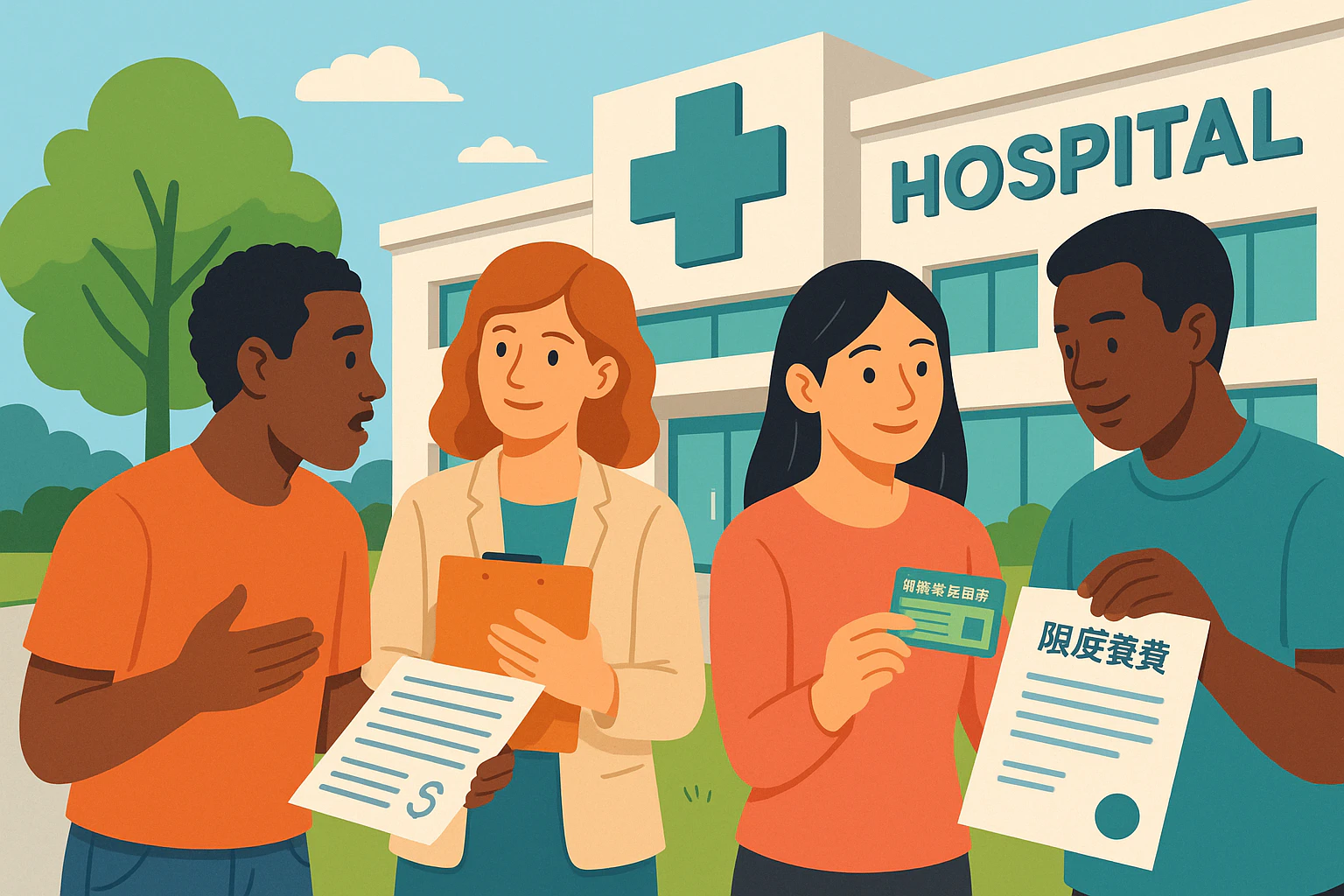
If you are about to be admitted: tell the hospital you want the monthly ceiling applied before you pay by either using your My Number Card as a health insurance card or showing a Limited Cost Approval Certificate.
Key counters: the hospital admissions or billing desk, your city or ward office's National Health Insurance section, or your employer's insurer or Kyokai Kenpo branch.
Deadlines: later reimbursement usually starts about 2 to 4 months after the treatment month, and claims generally expire after 2 years. If you already paid, keep every receipt and apply anyway.
Information current as of March 2026 based on Digital Agency guidance, MHLW foreign-language materials, and English guidance from Yokohama City, Inagi City, and Taito City's English NHI guide.
If you are frantically searching for the high-cost medical expense Japan rules after a hospital call, here is the short version: you may not need to pay the scary amount first. Japan's public insurance has a monthly ceiling, but the fastest route is not the later refund. The fastest route is to get the cap applied upfront.
When I worked as a Medical Coordinator for Foreign Patients at a hospital in Osaka, I saw this panic again and again. The problem was rarely a total lack of support. The problem was that people did not know which desk, which card, or which certificate would stop the bill from exploding in the first place.
Who can use Japan's high-cost medical expense system
This is not a special program for foreigners. It is the normal safety net inside Japan's public health insurance.
- You can use it if you are enrolled in Japanese public health insurance: National Health Insurance through your city or ward office, employees' health insurance through your employer, or the late-stage elderly system.
- Foreign residents use the same basic rules as Japanese residents once they are properly enrolled.
- Short-term visitors usually cannot use this playbook because it assumes Japanese public insurance coverage. For international visitors, MHLW points people to private travel insurance instead.
The ceiling depends mainly on age and income. For most working-age readers, the under-70 table below is the one that matters. If you are 70 or older, use the separate 70-plus table in Yokohama City's guide because the structure changes.
| Item | Amount/count | Source/as of date |
|---|---|---|
| Under 70, highest income category | ¥252,600 + (medical expenses - ¥842,000) × 1%; from the 4th eligible month: ¥140,100 | Yokohama City English NHI guide, August 2025 |
| Under 70, upper-middle income | ¥167,400 + (medical expenses - ¥558,000) × 1%; from the 4th eligible month: ¥93,000 | Yokohama City English NHI guide, August 2025 |
| Under 70, standard working-age income | ¥80,100 + (medical expenses - ¥267,000) × 1%; from the 4th eligible month: ¥44,400 | Yokohama City English NHI guide, August 2025 |
| Under 70, lower income | ¥57,600; from the 4th eligible month: ¥44,400 | Yokohama City English NHI guide, August 2025 |
| Under 70, resident-tax-exempt household | ¥35,400; from the 4th eligible month: ¥24,600 | Yokohama City English NHI guide, August 2025 |
Important: this is calculated by calendar month, not by a rolling 30 days. A stay that crosses from March 31 into April 1 can create two separate calculations.
Use My Number or a certificate to cap the bill upfront
If you are about to be admitted, this is the section that matters most. There are two fast upfront routes.
- Use your My Number Card as your health insurance card. The Digital Agency says that when you use a My Number Card registered as a health insurance card, you do not have to temporarily pay the high amount at the counter and you do not need advance paperwork at the government office. The MHLW's current English brochure for foreign residents explains that you can register either at a medical institution or pharmacy reader or in advance on Mynaportal, then verify with facial recognition or your 4-digit PIN.
- Show a Limited Cost Approval Certificate. The official English name is usually Eligibility Certificate for Ceiling-Amount Application, and the Japanese name is 限度額適用認定証. If you are not using a registered My Number Card, apply for this through your insurer: for National Health Insurance, that usually means your city or ward office; for employees' insurance, it means your insurer such as Kyokai Kenpo or your health insurance society.
For anyone searching how the My Number card hospital bill limit actually works, the key is this: the hospital has to see your ceiling information before settlement. Do it at the admissions desk or payment machine, not after discharge if you can help it.
Three phrases you can use right now:
- マイナンバーカードを健康保険証として使いたいです。 (Mainanbaa kaado o kenkou hokenshou to shite tsukaitai desu.) — I would like to use my My Number Card as my health insurance card.
- 限度額適用認定証を使いたいです。 (Gendogaku tekiyou ninteishou o tsukaitai desu.) — I want to use a Limited Cost Approval Certificate.
- 今月の自己負担上限額を確認してください。 (Kongetsu no jiko futan jougengaku o kakunin shite kudasai.) — Please confirm my monthly out-of-pocket ceiling.
If this feels overwhelming, that is exactly why I built LO-PAL — you can post your question for free and get answers from local Japanese people who know your area. If you need hands-on help calling the hospital or sorting insurer paperwork, you can also request a task, and you only pay when the work is done.
If your problem is the My Number setup itself, the Digital Agency's toll-free My Number line is 0120-95-0178. Menu 5 covers use of the card as a health insurance card, and the official page lists support in English, Chinese, Korean, Spanish, Portuguese, Vietnamese, Thai, Indonesian, Tagalog, and Nepali.
One foreign resident shared on Reddit that the hospital's card reader asked whether they wanted to share the monthly high-cost limit, and once they agreed, the bill was capped with no extra paperwork.
Individual experiences vary. Use your hospital and insurer's official instructions for your own case.
One extra warning: if you are in a low-income category, some insurers still require advance certification for reduced standard charges or meal reductions even when you use My Number. If that might be you, ask the insurer before admission rather than assuming the reader will handle everything.
What to do if you already paid too much
If the money is already gone, you still may recover the excess. This is the hospital bill reimbursement Japan route.
- Keep every receipt and itemized statement. Keep hospital, clinic, and outside pharmacy receipts for the same month. Do not rely on memory.
- Watch for the application form from your insurer. Taito City's English guide says eligible households generally receive a high-cost medical expense application about 3 to 4 months after treatment. Yokohama says it generally sends the notice about 2 months after the eligible month.
- Apply even if the bills were split. If the same month involved more than one institution, or if the hospital could not apply the cap upfront, the excess may still come back later.
- Chase it if nothing arrives. Yokohama tells residents to contact the National Health Insurance section if they do not receive the notice within about 3 months from the applicable month. For employees' insurance, contact your insurer directly.
| Item | Amount/count | Source/as of date |
|---|---|---|
| Application form usually sent | About 2 to 4 months after the treatment month | Yokohama City guide, August 2025; Taito City guide, 2025 English edition |
| Refund after application is accepted | About 1 to 2 months | Taito City guide, 2025 English edition |
| General claim deadline | Within 2 years | Taito City guide and Yokohama City guide |
If you need to ask at the counter or on the phone, use this:
- 高額療養費の払い戻しを申請したいです。 (Kougaku ryouyouhi no haraimodoshi o shinsei shitai desu.) — I would like to apply for a high-cost medical expense reimbursement.
- 申請書はいつ届きますか。 (Shinseisho wa itsu todokimasu ka.) — When will the application form arrive?
Do not miss the deadline because you assumed the refund was automatic. Some insurers calculate and send forms proactively, but you should still follow up if the notice does not come.
Another foreign resident on Reddit described paying a bill first and then later receiving refunds by mail from the local government once the high-cost system was processed.
Individual experiences vary. Official timing depends on your insurer and municipality.
Why your bill still looks wrong and how to fix it
This is the part that creates the most anger. A bill can look wrong even when the system is working exactly as designed.
- The calculation is by calendar month. Treatment from the 1st to the last day of one month is grouped together. Crossing into a new month starts a new calculation.
- It is calculated separately by hospital or clinic. Going to two different places in the same month can mean two separate upfront payments.
- Inpatient and outpatient are separated even at the same hospital.
- Dental is separated from the hospital's other departments.
- Outside pharmacy costs may count, but meals, utilities during hospitalization, private-room surcharges, pajama rental, and other non-covered items do not.
- If you are under 70, not every small receipt combines. Yokohama's guide says receipts of ¥21,000 or more per institution per month are the ones counted toward the calculation for under-70 patients.
- From the 4th eligible month onward, the cap can drop. This is the multiple-occurrence rule shown in Yokohama's table.
This is why someone can correctly use My Number or a certificate and still think the total is off. The hospital can cap the portion it can see, but a later adjustment may still be needed when another clinic, another month, or another pharmacy gets added.
Ask the billing desk these questions before assuming the hospital made a mistake:
- この請求は保険診療と保険外費用が分かれていますか。 (Kono seikyuu wa hoken shinryou to hoken-gai hiyou ga wakarete imasu ka.) — Does this bill separate insured charges and non-covered charges?
- 食事代と差額ベッド代は含まれていますか。 (Shokujidai to sagaku beddo-dai wa fukumarete imasu ka.) — Does this include meal charges and private-room charges?
- 同じ月の薬局分も高額療養費の対象ですか。 (Onaji tsuki no yakkyoku-bun mo kougaku ryouyouhi no taishou desu ka.) — Are pharmacy charges from the same month also eligible for the high-cost calculation?
And check these practical points:
- Did the hospital actually read your My Number Card and receive your ceiling information?
- Did you recently change jobs, move cities, or switch insurers?
- Are you looking at a bill that includes non-covered extras?
- Did the stay cross into a new month?
One Reddit user wrote that they were confused by a hospital bill of about ¥276,000 even though they had already confirmed a lower maximum payment amount before hospitalization.
Individual experiences vary, but this is exactly the pattern I see most often: the bill is split in a way the patient did not expect.
If your eligibility itself is the issue, read our clinic playbook for using a Shikaku Kakuninsho when your insurance card setup is a mess. If you recently quit a job, also check whether you need to keep Kyokai Kenpo after leaving or switch promptly through city hall.
Related Articles
- Health insurance card expired in Japan? Use Shikaku Kakuninsho before the clinic turns you away
- Keep Kyokai Kenpo after you quit
- My Number Card application for foreigners in Japan
Get Help Calling the Hospital Before You Pay
If you are stuck between the hospital desk, city hall, and your insurer, ask on LO-PAL. Posting your question is completely free, and a local Japanese helper can call the hospital, check what documents you need, confirm whether language support is available, and even go with you if needed. If you request hands-on task help, you only pay when the job is completed.
Written by

Founder, LO-PAL
Former Medical Coordinator for Foreign Patients (Ministry of Health programme) and legal affairs professional. Built LO-PAL from firsthand experience navigating life abroad.
Written with partial AI assistance
Read full bio →