Unpaid Japanese Health Insurance Premiums? Your June 2027 Visa Renewal Could Fail
From June 2027, Japan's Immigration Services Agency begins verifying health insurance and pension premium payment at visa renewal. Only 63% of foreign NHI enrollees are currently paid up. This guide explains who's at risk, what counts as "intentional" non-payment, and the 2-year statute of limitations that caps your recovery scope.
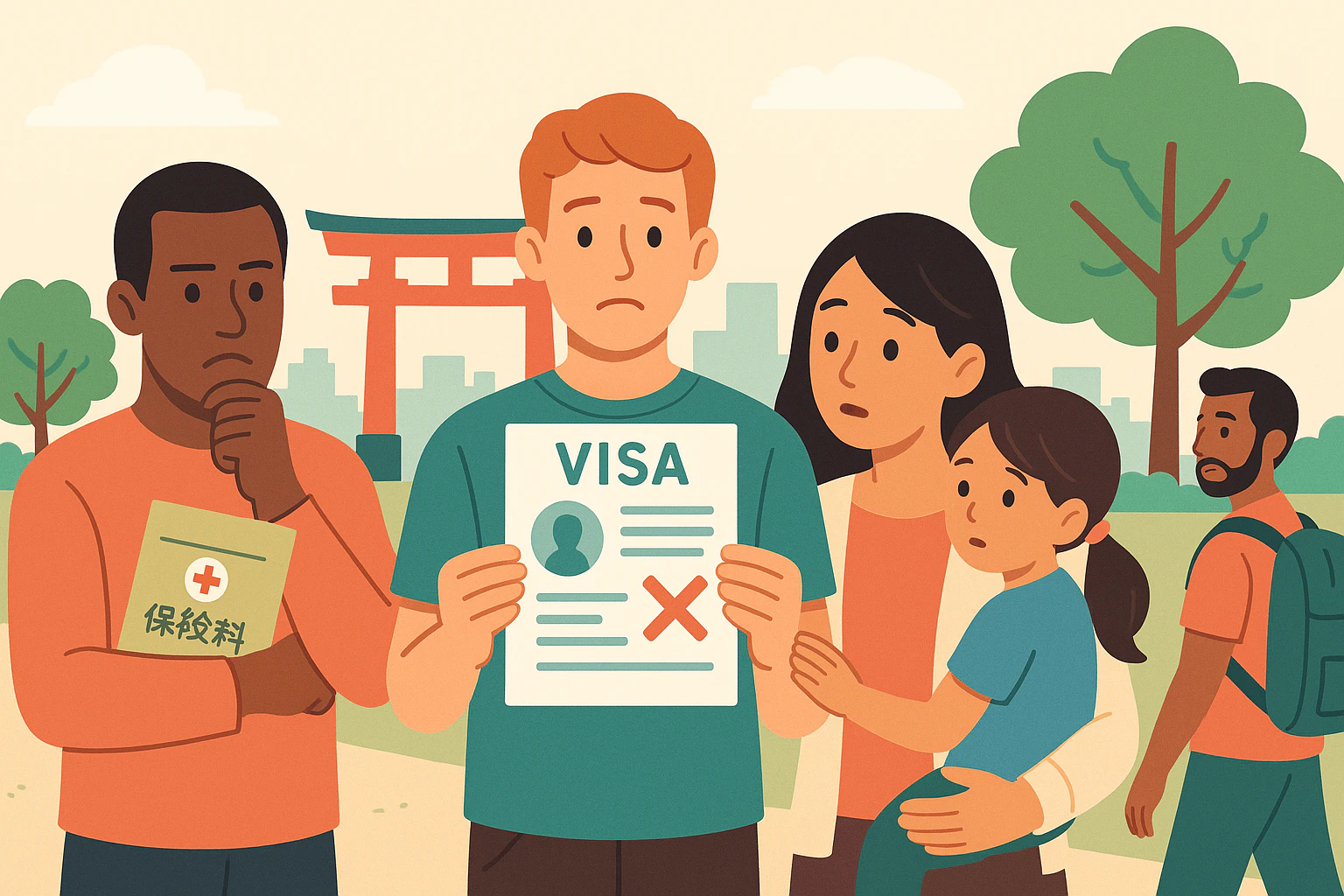
Fast answer: From June 2027, Japan's Immigration Services Agency (ISA) begins verifying whether foreign visa applicants have paid their National Health Insurance (国保) and National Pension (国民年金) premiums. Intentional non-payers face visa renewal denial, status change denial, and permanent residence rejection.
The scope:
- What's checked: 国民健康保険料 (NHI premiums), 国民年金保険料 (pension premiums), 住民税 (resident tax)
- Who's affected: freelancers, self-employed, 経営・管理 visa holders, between-job foreigners — anyone who self-pays these premiums. Salaried workers with 社保 (SHI) are largely exempt because deductions are automatic.
- Current compliance rate: only 63% of foreign NHI enrollees are fully paid-up (vs 93% for the total population, per MHLW FY2024 data)
The silver lining: Japan's statutes of limitations mean past-due premiums become unrecoverable after 2 years. If you're behind, pay the recoverable portion, get 納付証明書, and document a turnaround. Applications are judged on intentional non-payment — not historical accidents.
Information current as of April 2026 based on the 2026年1月23日 Cabinet Decision "外国人の受入れ・秩序ある共生のための総合的対応策", ISA comprehensive response measures page, ISA permanent residence guideline, Japan Pension Service exemption application page, and MHLW data published April 2025.
On January 23, 2026, the Japanese cabinet officially decided to link Immigration records with local tax authorities, municipal health insurance systems, and the Japan Pension Service. Starting June 2027, when you apply to renew your 在留期間 or change status, ISA will check whether you've paid your public obligations. This article explains exactly what's being checked, who is most at risk, and the recovery path if you have outstanding arrears.
What the rule actually says
The 2026/1/23 Cabinet decision ("外国人の受入れ・秩序ある共生のための総合的対応策") directs the following:
- Information linkage between ISA, municipalities, and the Japan Pension Service on NHI premium payment status, pension premium payment status, and resident tax payment status
- Designation of intentional non-payment of premiums or taxes as grounds for denial of 在留資格更新 (status renewal), 変更 (change of status), 認定 (initial recognition), and 永住 (permanent residence)
- System integration completing by March 2027; enforcement at visa examinations beginning June 2027
Sources: the Cabinet decision is the definitive reference; ISA has not yet published a bilingual operational guideline as of April 2026. The operational details — what "intentional" means, what months count, what documents to bring — are expected in an ISA implementation notice before June 2027.
Who's actually at risk
| Your situation | Direct exposure? |
|---|---|
| Full-time employee with 社会保険 (SHI / 健保 + 厚生年金) | Low — premiums auto-deducted from payroll; unpaid arrears usually indicate employer fraud, not your choice |
| Freelancer / sole proprietor under 国保 + 国民年金 | High — you pay manually, and missed months accumulate fast |
| 経営・管理 visa holder running a small company | High — typically covered by 国保 + 国民年金; cash flow issues lead to missed premiums |
| Between jobs, on 任意継続 or 国保 | Medium-to-high — short gaps are common but accumulate if prolonged |
| 配偶者ビザ / 永住 / 定住 dependents | Low-to-medium — often in Category 3 (被扶養配偶者) with premiums waived, but higher-income spouses cross into own payment |
| Student visa holder | Medium — students must pay 国保 but can often apply for 学生納付特例 to defer 国民年金 |
| 高度専門職 | Low — usually 社保 through sponsor employer |
The policy explicitly targets self-paid premium systems (国保, 国民年金), not deductions at source. If you're fully salaried and your payslip shows both 健康保険料 and 厚生年金保険料 every month, you're not the target audience — verify with a recent payslip and keep moving.
Current statistics — what the data actually shows
MHLW published FY2024 figures in April 2025, summarizing payment rates from a 150-municipality sample:
- Foreign NHI enrollees payment rate: 63% (vs 93% for all enrollees combined)
- Foreign 国民年金 payment rate: approximately 43% (per 衆議院 question response; some sources cite 49.7%)
- Foreign share of total NHI medical expenses: 1.39% — lower than their 4.0% share of enrollees, meaning foreign residents on average use less medical care than they pay premiums for
The 63% compliance rate is what makes this rule high-stakes: over one in three foreign NHI members are currently carrying some level of arrears. If that's you, keep reading.
What does "intentional" non-payment mean?
This is the key uncertainty as of April 2026. The Cabinet text specifies "故意に" (intentionally) non-paying. ISA's operational guideline, not yet published, will define what evidence qualifies as intentional.
Based on analogous existing rules (tax non-compliance and permanent residence screening), expected criteria:
- Arrears duration: likely only long-term (6+ months) arrears will flag; a single missed month corrected promptly likely won't
- Response to payment guidance: municipalities send multiple reminders. Ignoring all of them, especially after a 督促状, suggests intent. Paying promptly after reminder usually does not.
- Financial capacity: someone earning ¥10M but paying ¥0 in NHI premiums will be scrutinized more than someone earning ¥2M who missed a few months during a low-income period
- Availability of 免除 / 猶予: failing to apply for available exemptions when income qualifies may be counted as "not using available remedies"
Short-term, one-time lapses — a month skipped during a job transition, a late payment during illness — are unlikely to trigger denial. Continuous multi-year non-payment with no exemption filed likely will.
What to bring to your visa renewal (starting June 2027)
ISA has not yet published an official checklist. Based on analogous permanent-residence document lists, likely requirements:
- 国保 納付証明書 (from your municipality — 国民健康保険課)
- 国民年金 納付証明書 (from the Japan Pension Service — 年金事務所 or 電子申請)
- Receipts for any arrears recently paid
- 免除・猶予 承認通知書 if low-income periods were covered by exemption
- 事情説明書 — written explanation if past arrears exist, confirming current full payment and describing why arrears occurred (job loss, illness, newcomer confusion, etc.)
- Salaried workers: a 健康保険被保険者証 / 資格確認書 / Myna 保険証 + 資格情報のお知らせ showing continuous SHI coverage
- Recent payslip — showing 健康保険料 and 厚生年金保険料 deductions (for SHI employees)
Starting early — say, October 2026 — is prudent. Getting a 納付証明書 takes 10 days minimum, longer if your records are old or spread across multiple municipalities.
Recovering from past arrears: the 2-year statute of limitations
Good news and bad news: Japanese statutes cap how far back you can pay, and how far back the government can collect.
国民健康保険料 (NHI premiums) — 2 years (or 5 years if your municipality charges it as a "tax")
Municipalities levy NHI in two forms: as 国民健康保険料 (premium, under 国民健康保険法 第110条 — 2-year statute) or as 国民健康保険税 (tax, under 地方税法 — 5-year statute). Most large cities use 保険税 (5 years); smaller municipalities often use 保険料 (2 years). Check your municipality's notice or ask 国保 counter which form applies to you. Older arrears past the applicable period are time-barred — the city cannot demand them, and you cannot voluntarily pay them either.
国民年金保険料 (pension premiums) — 2 years for standard payments
Normal payment of back pension is also limited to 2 years. A previous 10-year extended payment (後納制度) ended in 2018 and has not been restored. For months that were previously granted 免除 or 納付猶予, you can still use 追納 within 10 years to upgrade those months to full contribution — but this applies only to approved exemption months, not to unpaid-without-approval months.
免除・猶予 — retroactive eligibility
If your income during past unpaid months qualified for exemption (roughly: ¥670,000/year or lower for full exemption, graduated tiers above), you can apply for retroactive exemption up to 2 years and 1 month. If approved, those months are cleared from your arrears and counted partially toward your pension record.
This is the single most valuable recovery tool for foreigners who fell behind during low-income periods (early career, study, between jobs, illness). File the 免除申請書 at your city hall or 年金事務所 with your income records.
Step-by-step recovery path
- Order your records. Request 納付状況証明書 from your municipality (国保) and 被保険者記録照会 from the Japan Pension Service (年金). Free, takes about a week.
- Identify 2-year-eligible arrears. Anything older is statute-barred — you can't pay it, and it won't be held against you for unreachable past years.
- Apply for retroactive exemption on low-income months. File 国民年金免除申請 at the 年金事務所 with supporting income documentation. This is often the biggest single win.
- Pay up recoverable arrears. Pay the municipal 国保 arrears and the pension months that don't qualify for exemption.
- Obtain fresh 納付証明書. Request both 国保 and 国民年金 納付証明書 after payments clear. These are your proof for ISA.
- Prepare 事情説明書. A one-page written statement in Japanese (translation optional) explaining why arrears occurred, what circumstances changed, and confirming current compliance. Keep tone factual — no excuses, just chronology.
- File your visa application with all documents.
Specific scenario walkthroughs
Scenario A: New freelancer who didn't know
Arrived 2024, started freelancing 2025, didn't enroll in 国民年金 until someone mentioned it in March 2026. Owes 12 months of premiums at ¥17,510/month = ¥210,120. Income in 2025 was ¥2.5M (above exemption).
Path: Pay 12 months immediately; file 国民健康保険加入 if not yet done; obtain fresh 納付証明書 within 30 days. For visa renewal in summer 2027, document is in good order, and a brief 事情説明書 acknowledging the gap with "confirmed enrolled and fully paid since [date]" is sufficient.
Scenario B: Student whose family pays tuition but not insurance
Arrived 2023 as 留学生; family in home country did not understand they needed to pay 国保 and 国民年金. Now in 2026 and 3 years behind.
Path: Only most recent 2 years of 国保 arrears are recoverable — pay those. For 国民年金, file 学生納付特例 申請 retroactive up to 2 years 1 month — most likely approved given student status. Remaining unreachable period: clean under statute of limitations. Result: student is fully caught up within the legal recovery window, and 特例 covers the approved months toward future pension eligibility.
Scenario C: Between-jobs lapse
Lost job July 2025, was on 任意継続 for 2 months, dropped off unintentionally, resumed work November 2025 under 社保. September-October gap unpaid.
Path: Small, short gap — pay the 2 months of 国保 at your city office (likely ¥30,000–60,000 depending on prior income). Obtain 納付証明書. Optionally mention the gap in 事情説明書 for visa renewal.
Scenario D: 経営・管理 visa holder with 5 years of accumulated unpaid
Running small company, cash flow issues, avoided paying 国民年金 since 2021.
Path: Hardest case. Only 2 years of 国保 and 国民年金 are recoverable. For earlier unpaid years, request income records and file retroactive 免除 where qualifying. Beyond that, unpaid years are lost from pension record but cannot be "paid back" to satisfy ISA. Build documented turnaround: current 12+ months of payments, 納付証明書, and detailed 事情説明書 explaining business reality. Consider consulting a 行政書士 experienced in 在留資格 before filing.
The pension side — often overlooked
Most discussion centers on 国保, but 国民年金 is included in the same check. Foreign 国民年金 payment rate is estimated at only 43% — even lower than NHI. Key actions:
- Apply 免除/猶予 aggressively when eligible. The thresholds are generous (full exemption at ~¥670,000/year single).
- 学生納付特例 is a lifesaver for students — it defers premiums without creating "unpaid" periods, and can be applied retroactively up to 2 years 1 month.
- Understand the 10-year 追納 window — exempted months can be later paid in full within 10 years to restore full pension amount. This is relevant for long-term compliance building but doesn't resolve visa checks directly.
For the full pension decision tree, see our Japan Pension for Foreigners guide.
What's NOT known yet (as of April 2026)
Important uncertainties to watch before June 2027:
- Exact unpaid-month threshold ISA will use for denial
- Whether retroactive 免除 applied within the 2-year 1-month window is counted as "paid" or "missed" by ISA
- Official bilingual document checklist
- Treatment of newcomers (first 12 months in Japan) — whether enrollment lag gets different treatment than established residents
- Whether SHI employees of non-compliant employers (the force-shakai-hoken situation) will be separately handled
ISA typically publishes operational guidelines 6–12 months before enforcement. Expect a detailed Q&A sometime between September 2026 and February 2027.
What to do this year (2026)
- April–May 2026: Order 納付状況証明書 from your municipality and 年金事務所. Identify any arrears.
- May–July 2026: File retroactive 免除 / 納付特例 for eligible months. Pay down recoverable arrears.
- August 2026: Obtain fresh 納付証明書. File these in a folder with expected renewal documents.
- October 2026–onwards: Maintain clean monthly payment. Watch for ISA official guidance on June 2027 requirements.
- 2027 H1: Before your next renewal, re-request updated 納付証明書 (not older than 3 months).
The bottom line
The June 2027 rule is real, coming, and most impactful for foreign residents on self-paid insurance systems — freelancers, 経営・管理 holders, and anyone between jobs. Salaried SHI workers should be fine as long as employers are compliant.
If you have past arrears, don't panic and don't ignore them. Japan's 2-year statute of limitations caps your recovery scope at a manageable level; retroactive exemption applications clear additional months from your record if income qualified. Start the process in summer 2026, not summer 2027. By the time the rule activates, your paperwork should already be clean.
For the full insurance context: Health Insurance in Japan: 5 Mistakes That Cost Foreigners. For pension specifically: Japan Pension for Foreigners. If your employer is the reason you're not enrolled: How to Make Your Employer Enroll You in Shakai Hoken Now.
Written by

Founder, LO-PAL
Former Medical Coordinator for Foreign Patients (Ministry of Health programme) and legal affairs professional. Built LO-PAL from firsthand experience navigating life abroad.
Written with partial AI assistance
Read full bio →