Tokyo for Foreign Families 2026: Daycare, Schools & Family Visas
Tokyo has Japan's largest foreign-family community: 80,547 dependent-visa and 189,521 permanent residents. Daycare waitlists fell to 339 citywide in 2025.
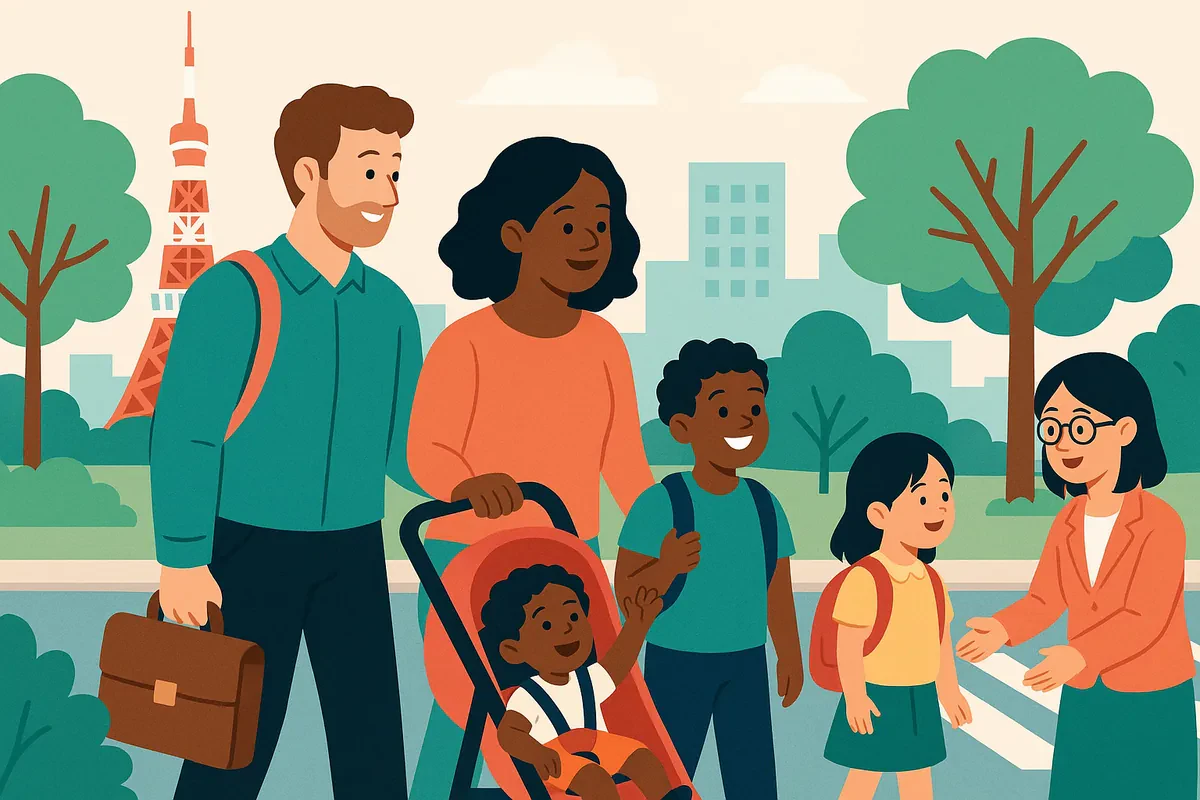
If your family is moving to Tokyo — or you arrived first on a work visa and your spouse and children are now joining you — the reassuring news is that you are not doing anything unusual. Tokyo is, by a wide margin, the part of Japan where the most foreign families already live, so the daycare, school, health-insurance and city-hall systems here have more day-to-day experience with non-Japanese parents than anywhere else in the country. This guide walks through the practical side of raising a family in Tokyo's 23 wards in 2026: where families actually settle, what family-size rent really costs, how the daycare (hoikuen) system works now that waitlists have collapsed, what public and international schooling look like, and how the visa, health-insurance and child-support pieces fit together.
2026 quick takeaway: Tokyo is home to 80,547 "Dependent" (family-stay) residents and 189,521 permanent residents — both the highest of any prefecture (as of 30 June 2025). And the old reputation of Tokyo as "daycare-waitlist hell" is out of date: citywide, only 339 children were on daycare waitlists, with 33 municipalities at zero (as of 1 April 2025).
Whether you are still choosing a ward or a company relocation already assigned you a neighborhood, the sections below are meant to be useful after you land, not only while you plan. For how Tokyo compares with the rest of the country, see our overview of the best prefectures for foreigners in Japan and our broader guide to living in Tokyo.
Why Tokyo tops Japan for foreign families
Tokyo holds Japan's largest foreign population overall — 775,340 residents as of 30 June 2025, roughly a fifth of the national total, climbing to 801,438 by the end of 2025 as Japan passed 4.12 million foreign residents for the first time. But the figures that matter most to parents are the family ones, and Tokyo leads every family-relevant category:
- Dependent visa (kazoku taizai): 80,547 people — number one nationwide, and 24.8% of all such residents in Japan (30 June 2025). This is the status most spouses and children of work- or student-visa holders live on.
- Permanent residents (eijusha): 189,521 — also the highest of any prefecture (30 June 2025), a sign of how many foreign families put down long-term roots here.
The single largest nationality in Tokyo is Chinese, at 294,826 residents (30 June 2025), but the community is genuinely mixed, with sizeable Korean, Vietnamese, Nepali, Filipino, Indian and Burmese populations. One practical note before we go further: Japan reports these numbers through two different systems. Prefecture-level, visa-by-visa figures (like the 80,547 above) come from the Immigration Services Agency and are dated 30 June 2025; ward-level, nationality-by-nationality figures come from the resident registry (juminhyo) and are dated 1 January 2025. They are close but not identical, so we label each one rather than mixing them.
Where foreign families live, and what family-size rent costs
Across the 23 wards there are 605,506 foreign residents (resident registry, 1 January 2025), out of 721,223 in Tokyo as a whole. Ward-level data is only broken down by nationality, not by visa type, so there is no official count of "family-stay residents in ward X" — treat any such claim with suspicion. What families really weigh is space, rent and access to schools.
Rent is where the ward you pick hits your budget hardest. For a family-size apartment (2LDK/3K/3DK), the SUUMO market average ranges from about ¥12.2万 in Katsushika to ¥37.1万 in Minato (as of 10 July 2026) — a roughly threefold spread inside the same city. The three cheapest wards for family-size rent are Adachi (¥13.1万), Katsushika (¥12.2万) and Edogawa (¥12.9万), and these eastern wards also hold some of Tokyo's largest and most established foreign communities: Edogawa alone has 47,932 foreign residents, including 7,484 Indian residents (resident registry, 1 January 2025) — Nishi-Kasai is widely known as Tokyo's Indian neighborhood, complete with Indian grocery stores and international-school demand. More expensive, park-heavy family wards such as Setagaya (family-size rent about ¥19.7万) trade a higher rent for more space and greener streets. When you reach the point of actually signing, our guide to rental contracts, guarantors and fees explains the deposit, key money and guarantor system that trips up first-time foreign renters, and our list of five reasons foreign applicants get rejected helps you avoid the common screening pitfalls.
Daycare (hoikuen): the waitlist era is largely over
For years, "getting into hoikuen" was the horror story of raising a child in Tokyo. That reputation is now outdated. Citywide, waitlisted children fell to 339 as of 1 April 2025, and 33 of Tokyo's 62 municipalities recorded zero waitlisted children. The highest count among the 23 wards was Setagaya, with 47 (1 April 2025); the next-highest figures, Machida (40) and Hino (30), are cities in the western Tama area rather than the central 23 wards.
The important nuance for families: the numbers still differ ward by ward and change every year, and Tokyo does not publish a full per-ward breakdown beyond the top few, so do not assume a given ward is "solved" — check the ward you are targeting directly. Licensed (ninka) daycare is allocated through your ward office using a points system (shisu) that ranks households by need — two parents working full-time score higher than one, for example. Our ward-by-ward Tokyo daycare guide covers how the 23 wards differ, while the hoikuen application walkthrough and the explainer on the daycare point system show exactly how to apply and score. For the paperwork and language issues specific to non-Japanese parents, start with daycare for foreign parents in Japan.
Two more things are worth knowing. First, a newer national scheme, the "any child can attend" (kodomo dare-demo tsuen) program, is being rolled out to let even children who are not formally enrolled attend daycare on an hourly basis — useful for at-home parents. Second, daycare fees (hoikuryo) are set by income band and vary by ward, and they are revised periodically, so we point you to the internal guides above rather than quote a figure that may not apply to your household.
School: free multilingual support, plus international options
Any child resident in Tokyo can attend a Japanese public elementary or junior-high school, and the language support is better than most newcomers expect. The Tokyo Metropolitan Board of Education publishes school-enrollment guidance and support materials in more than a dozen languages — including Chinese, Korean, English, Spanish, Vietnamese, Nepali, Tagalog and Portuguese — and runs an enrollment-consultation line (03-5320-6893). Nationally, the education ministry's school guidebook is available in eight languages. This support is not a niche service: 69,123 children in Japan's public schools needed Japanese-language instruction as of the 2023 school year, about 1.8 times the figure a decade earlier. Our guide to Japanese public school for foreign parents explains enrollment, and the school-supplies checklist covers the randoseru, uniform and gym-kit shopping that surprises many families.
Tokyo also has Japan's largest concentration of international schools, from English-medium and IB programs to national-curriculum schools. There is no single official register of them, though, so we deliberately avoid quoting a school count — confirm tuition, curriculum and openings with each school directly. For anything you cannot navigate alone, Tokyo's multilingual consultation line (TMC Navi) answers general living questions in 16 languages on 0120-142-142.
Having a baby: birth costs, child allowance and child medical care
If you are having a child in Tokyo, the sequence is well worn: register the pregnancy at your ward office to receive a Mother-and-Child Handbook (boshi kenko techo) and subsidized prenatal checkups, then claim the lump-sum childbirth allowance after delivery and, once the baby is registered, the monthly child allowance. Because the exact amounts and eligibility rules are set nationally but administered locally — and are periodically revised — we route you to the detailed guides rather than quote figures that may change: having a baby in Japan as a foreigner, the child allowance explainer, and how childbirth costs are being made effectively free.
After birth, the piece that varies most from ward to ward is the child medical subsidy (kodomo iryohi josei): wards subsidize children's medical bills, but the cutoff age and any small copay differ, and these rules are revised fairly often. Every ward runs this slightly differently, so before you assume a rule applies to you, it helps to ask a local parent who has actually been through it — you can do exactly that on LO-PAL and get a gut check for your specific ward.
Health insurance for the whole family
How your family gets covered depends on your own insurance. If you are on employees' health insurance (shakai hoken) through a company, your spouse and children can usually be added as dependents (fuyo) at no extra premium; if you are on National Health Insurance (kokumin kenko hoken), each resident enrolls and the household is billed together. Either way, the child medical subsidy above then reduces what you actually pay for a pediatric visit. Our guides to health insurance for foreigners and adding family members to your insurance walk through the enrollment steps and the documents you will need.
When someone gets sick and your Japanese is not up to a clinic conversation, Tokyo runs a medical-guidance service called "Himawari": the Japanese line is 03-5272-0303, and there is a foreign-language line on 03-5285-8181 in English, Chinese, Korean, Thai and Spanish (confirm the current hours when you call). Muslim families can also plan ahead with our guides to halal-friendly hospitals in Tokyo and Muslim-friendly areas to live.
Family visas and the road to permanent residence
Most foreign families in Tokyo are here on one of two statuses: the Dependent visa (kazoku taizai), for the spouse and children of a work- or student-visa holder, or Spouse of a Japanese National (Nihonjin no haigusha to), for those married to a Japanese citizen. A key point for planning: family-visa and permanent-resident holders choose freely where in Japan they live, unlike company-placed trainees — so your ward is genuinely your decision. Many families eventually aim for permanent residence, and Tokyo, with the most permanent residents in the country, is full of households that have made that move.
Permanent residence and spouse visas carry income, residence-length and documentation requirements that change over time, so treat the specifics as something to confirm with Immigration rather than lock in from a blog. Start with our guides to the spouse visa, permanent residence through marriage, and the income requirement for permanent residence. In person, the Tokyo Regional Immigration Services Bureau at 5-5-30 Konan, Minato-ku (near Shinagawa Station) is open weekdays 9:00–16:00, and the Tachikawa and Shinjuku branch offices also serve Tokyo residents. Because these rules genuinely shift, and because each ward's schools and child-support rules differ, it is worth getting a real-world read before you commit — on LO-PAL, you can ask a local Japanese resident your specific question. Once the visa and housing are settled, our checklist of things new arrivals set up too late keeps the rest of your first year on track.
Frequently asked questions
Is Tokyo really that hard for daycare?
Not the way it once was. Citywide, only 339 children were on daycare waitlists as of 1 April 2025, and 33 of 62 municipalities had zero. The highest among the 23 wards was Setagaya at 47. Numbers still vary by ward and change yearly, so check your target ward directly.
Can my children attend Japanese public school, and is there language help?
Yes. Any resident child can enroll at no tuition, and the Tokyo Metropolitan Board of Education provides enrollment guidance in more than a dozen languages plus a consultation line (03-5320-6893). Nationally, 69,123 public-school children needed Japanese-language support in 2023, so schools are used to it.
Which Tokyo wards are cheapest for a family-size apartment?
On the SUUMO market average, Katsushika, Adachi and Edogawa are cheapest for 2LDK/3K/3DK homes at about ¥12.2万–13.1万, versus ¥37.1万 in Minato (as of 10 July 2026) — roughly a threefold difference within the same city.
Can my spouse and children live in Tokyo on my work visa?
Yes, typically on the Dependent (kazoku taizai) visa. Tokyo hosts 80,547 family-stay residents, the most of any prefecture (30 June 2025). Dependent-visa and permanent-resident families choose freely where they live in Japan.
How do we get medical help in our language?
Tokyo's Himawari service offers a foreign-language medical-guidance line on 03-5285-8181 in English, Chinese, Korean, Thai and Spanish. For general living questions, TMC Navi answers in 16 languages on 0120-142-142.
Written by

Founder, LO-PAL
Former Medical Coordinator for Foreign Patients (Ministry of Health programme) and legal affairs professional. Built LO-PAL from firsthand experience navigating life abroad.
Written with partial AI assistance
Read full bio →