
Earthquake on Train Japan: What Foreign Residents Should Do
A commuter-first guide: stay safe during shaking, follow the 72-hour rule, and use Tokyo’s KitaCon DX LINE tool if stranded.
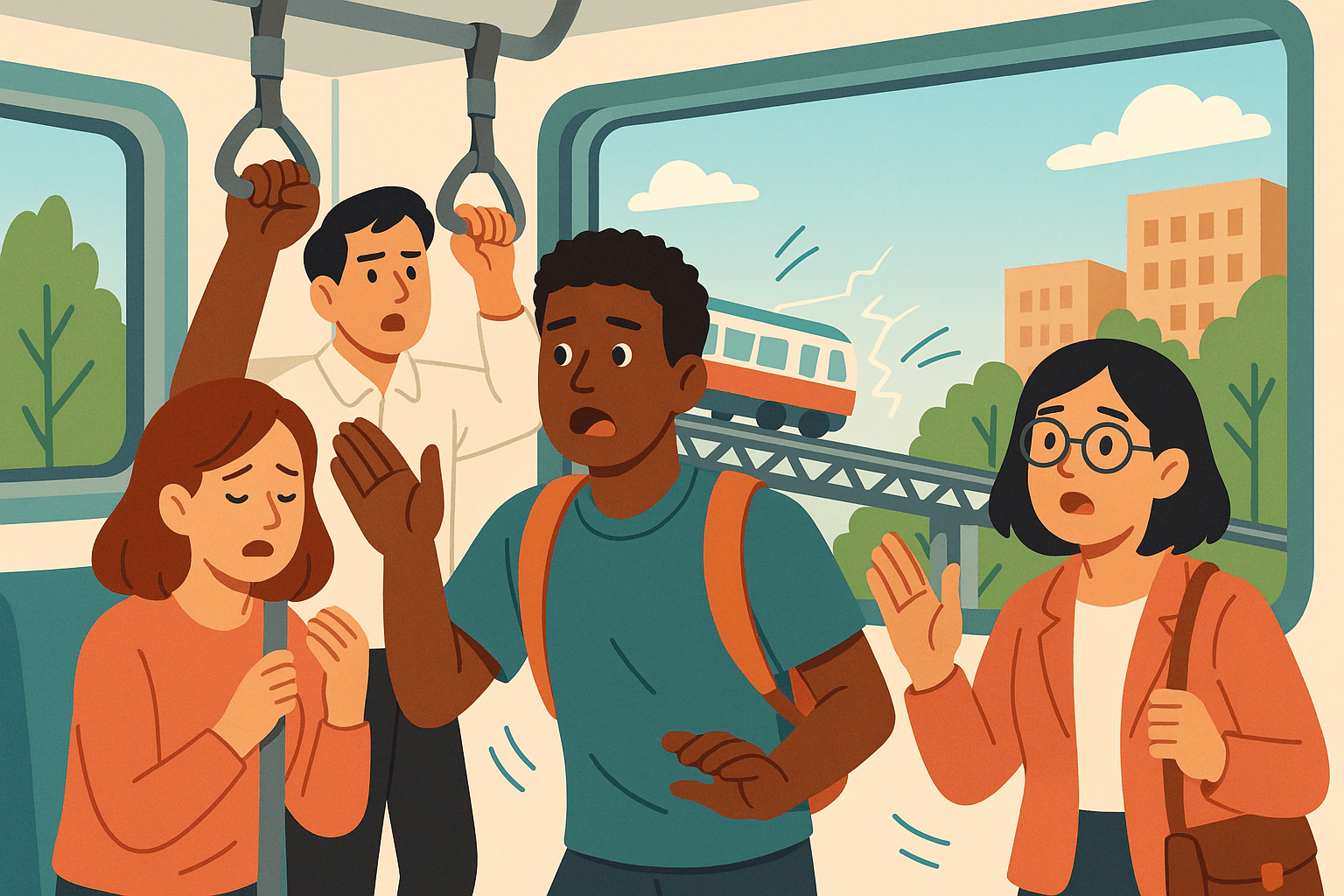
If you live in Japan long enough, you’ll eventually ask yourself: what happens if a big quake hits while you’re commuting? This guide is written for foreign residents and visitors who want practical, Japan-specific steps—especially for the moments right after the shaking, when trains stop and you’re not sure whether to move or wait. If you remember only one phrase, make it this: earthquake on train Japan is less about “escape fast” and more about “stay safe, follow staff, then wait in the right place.”
Commuter-first plan: (1) protect yourself and follow crew instructions, (2) don’t rush home—Japan’s guidance emphasizes staying put for about 72 hours after a major quake, and (3) in Tokyo, use the 2025 tool KitaCon DX via LINE to find open temporary stay facilities.
Before it happens — the commuter emergency kit (what to carry daily)
A “commuter kit” is different from a home disaster kit. Your goal is to handle a few hours (or a full day) of walking, waiting, and low battery—without becoming a burden on crowded stations or emergency services.
Carry these daily (fits in a small pouch)
- Portable charger + cable (and keep your phone in low-power mode when needed).
- A little cash (ATMs and card terminals may be down; small bills help).
- Water (small bottle) and a compact snack (energy bar, nuts).
- Mask and alcohol wipes (crowded waiting areas are common after disruptions).
- Mini flashlight (or a phone light, but don’t rely only on your phone).
- Basic first aid (bandages, blister plasters, pain relief you can take).
- Plastic bags (trash, wet items, improvised rain cover).
- Small towel (very Japanese, very useful).
Keep a “stranded commuter stash” at work or school
Tokyo-area guidance commonly assumes you may need to wait where you are, not immediately travel. Some municipalities explicitly recommend planning to keep people safe in place and stocking 3 days of water, food, and blankets at workplaces. (For example, Bunkyo City highlights stocking 3 days of water/food/blankets as part of stranded-commuter preparedness.) Bunkyo City: “Suppress mass return home” guidance.
- Walking shoes (if you commute in business shoes or heels).
- Seasonal warmth (compact jacket, heat pack in winter).
- Contact card with: your name, address, emergency contact, allergies/meds.
- Small hygiene set (toothbrush, wipes).
During the quake — what to do inside the train and on the platform
In Japan, the safest move is usually the simplest: protect your body, stay calm, and follow railway staff instructions. Rail operators are trained for this, and systems like seismometers and emergency alerts are built into operations.
If you are inside the train car
- Hold on immediately: grab a strap/handrail and lower your center of gravity.
- Protect your head if you can (bag or arms), and avoid standing directly under luggage racks.
- Do not force doors open or try to exit on your own. Wait for crew announcements.
- Listen for the operator’s instructions and watch what local passengers do (calm, orderly movement is the norm).
Tokyo Metro’s passenger guidance explains that when strong shaking is predicted or detected using seismometers and early warning systems, trains stop immediately; passengers should hold on and follow train crew guidance rather than forcing an exit. Tokyo Metro (English): “In case of a major earthquake”.
If the train stops between stations
One of the biggest fears is being stuck in a tunnel or between platforms. Tokyo Metro states that even if a train makes an emergency stop between stations, it will, after confirming safety, try to proceed to the nearest station platform when possible; if it truly can’t move, crew will guide evacuation—again, the key is not exiting without instruction. Tokyo Metro (Japanese): “When a major earthquake happens”.
If you are on the platform
- Step away from the platform edge and be mindful of crowd movement.
- Watch overhead for signs, lighting, and other fixtures.
- Follow staff directions about where to wait (and don’t run for stairs unless instructed).
Japan’s official public guidance also emphasizes bracing yourself during emergency stops: if you’re standing, hold a strap or handrail and stabilize your stance; if you’re seated, protect your head. Government Public Relations Online: actions on trains/buses during a quake.
After trains stop — the 72-hour stay-put rule, where you can legally/actually wait, and how to find temporary stay facilities (Tokyo vs other regions)
This is where Japan differs from many countries: the “best” choice is often not to start walking home immediately. After a large earthquake, mass movement can cause injuries, block emergency vehicles, and expose you to falling debris and aftershocks.
Why Japan says “don’t rush home” (about 72 hours)
Tokyo Metro explicitly advises that after a large-scale earthquake you should avoid unnecessary movement and remain in a safe place for 72 hours, then move gradually after temporary stay facilities open. Tokyo Metro (Japanese): 72-hour guidance and temporary stay facilities.
Tokyo’s disaster-preparedness materials explain the logic: if huge numbers of stranded people try to return home at once, streets become congested and can block police, fire services, and Self Defense Forces during the first 72 hours, which are critical for life-saving operations. Tokyo disaster preparedness guide (English): why to avoid moving for 72 hours.
Where you can actually wait (and where you should not)
In practice, the “right” waiting place depends on what’s open, what’s safe, and what local authorities are asking people to do.
- Best case: your workplace/school/hotel stays open and can safely keep people inside.
- If you’re out in the city: look for guidance from station staff, building staff, and municipal disaster response information.
- Avoid guessing: wandering station-to-station can create crowd pressure and drains your phone battery fast.
Evacuation shelter vs. “temporary stay facility” (crucial difference)
Foreign residents often mix up these two concepts because the English word “shelter” is used loosely online. But in Japan they can mean different systems with different intended users.
- Evacuation shelters (避難所 / hinanjo): generally for people who cannot live at home due to damage (e.g., collapse) and cannot do “stay-at-home evacuation.”
- Temporary stay facilities for stranded commuters (一時滞在施設 / ichiji taizai shisetsu): places meant for people who are away from home and can’t return because transport is stopped.
Bunkyo City clearly states that evacuation shelters are for people who cannot do stay-at-home evacuation because their home is damaged, and that shelters are not assumed to accept stranded commuters. The same page also notes that in Tokyo, the Tokyo Earthquake Disaster Prevention Ordinance requires all workplaces to create a business disaster-prevention plan that includes stranded commuter measures. Bunkyo City: shelter vs. stranded commuter facilities + Tokyo ordinance note.
Not sure about your specific case? Ask a local Japanese person on LO-PAL for personalised advice.
What to do when trains stop after an earthquake in Japan (simple decision flow)
- Confirm immediate safety (injuries, fire/smoke, falling hazards).
- Stay where you are if safe (office, school, commercial building) and follow local instructions.
- If you must relocate (building unsafe), move to a designated waiting place guided by staff/authorities.
- Use official info sources (apps, operator announcements, municipal updates) rather than rumors.
- Only start traveling long distances when authorities indicate it’s safer and routes are clearer.
Tokyo: how to find temporary stay facilities with KitaCon DX (LINE)
Tokyo has a Tokyo-only tool that launched for disaster-time operations in 2025: the Tokyo Stranded Commuter Countermeasures Operation System, nickname KitaCon DX. The Tokyo Metropolitan Government press release (dated March 28, 2025) explains that by adding its LINE Official Account, people can search for nearby open temporary stay facilities and even complete admission procedures on a smartphone; it also links with the Tokyo Disaster Prevention Map and Tokyo Disaster Prevention App. Tokyo Metropolitan Government: KitaCon DX operations start (March 28, 2025).
If you’ve searched for “Tokyo KitaCon DX LINE temporary shelter”, the official concept is “temporary stay facilities” (一時滞在施設) for stranded commuters—not evacuation shelters (避難所).
- Before anything happens: add the LINE Official Account named 帰宅困難者対策支援.
- How to add it: in LINE’s friend search, search the ID @157tdhuh (as published by Tokyo). TMG: LINE account name and ID.
- During a disaster: use it to find which facilities near you are open and accepting people.
- Follow the facility’s process: KitaCon DX supports smartphone-based entry procedures when available.
Other regions (Osaka, Aichi, Fukuoka, etc.): what’s different
Outside Tokyo, you may still see “stranded commuter” measures, but the tools, names, and availability differ by prefecture/city. Your safest approach is to rely on (1) railway operator instructions, (2) municipal guidance, and (3) multilingual alert tools, then ask on-site staff where you can wait.
A practical search term for local government sites is: "stranded commuter temporary stay facilities (帰宅困難者 一時滞在施設)" + your city/ward name. Many wards/cities publish lists of facilities and opening rules (example: Bunkyo City’s list of temporary stay facilities for stranded commuters). Bunkyo City: temporary stay facility list (example).
English-friendly info sources (Safety tips, NHK World, multilingual shelter support) + When to ask a local via LO-PAL
When you’re stranded, information is a safety tool. Set up English-friendly sources now, because after a quake you may have low battery, crowded networks, and conflicting rumors.
Safety tips app (English earthquake alerts and more)
Japan’s Tourism Agency (MLIT) lists the official disaster tool “Safety tips” (last updated October 10, 2025). It describes the app as push-notifying Emergency Earthquake Alerts, tsunami warnings, and special weather warnings, plus response flowcharts, communication cards, and helpful links; it is supervised by the Japan Tourism Agency and supports 15 languages. Japan Tourism Agency: disaster tools for foreign travelers (Safety tips, updated Oct 10, 2025).
For a quick English explanation and the language list, JNTO’s Safety tips page summarizes the app’s push alerts and multilingual support. JNTO: Safety tips app overview (English).
NHK WORLD-JAPAN (reliable English updates)
During major disasters, NHK WORLD-JAPAN is widely used for English reporting and official-briefing coverage. Keep it bookmarked (and consider downloading content for offline use when possible), but still prioritize instructions from your local authorities and railway staff for immediate actions.
Multilingual help at shelters and facilities: “display sheets”
If you end up at a shelter or a temporary stay facility, signage may suddenly switch to emergency-mode Japanese. CLAIR (Council of Local Authorities for International Relations) provides downloadable multilingual display sheets designed for shelters and places where foreigners gather, so staff can quickly communicate key messages. CLAIR: Multilingual display sheets for disasters.
Understand unusual alert terms (so notifications don’t confuse you)
Some alerts use technical terms that don’t translate cleanly. The Japan Meteorological Agency provides a downloadable multilingual dictionary dataset for weather/disaster terminology and notes updates; for example, it shows an update on March 13, 2025 that includes additions related to earthquake-information terminology. JMA: multilingual dictionary data (updated March 13, 2025).
Newer advisory types you might see: “Hokkaido–Sanriku Subsequent Earthquake Advisory”
If you live in northern Japan (or your app covers nationwide alerts), you may see advisory names that look unfamiliar. In a press conference summary dated December 17, 2025, JMA stated that the “Hokkaido–Sanriku Subsequent Earthquake Advisory” (北海道・三陸沖後発地震注意情報) was issued for the first time since the system began operating in 2022, and it thanked residents for readiness actions like maintaining the ability to evacuate quickly and carrying emergency items. JMA: Director-General press conference summary (Dec 17, 2025).
When to ask a local via LO-PAL
Even with good apps, the hardest part is often “local reality”: which buildings are actually open, whether a facility is accepting people yet, what your ward’s rules are, and how to explain your situation politely in Japanese. That’s exactly where LO-PAL helps: post a question in your language, and local Japanese helpers in the area can respond with practical, on-the-ground context.
FAQ
These are the questions foreign residents most often ask right after a major quake disrupts trains.
Should I get off the train if it stops between stations?
Not unless staff instruct you to. Operators may try to move the train to the nearest platform after confirming safety, and if evacuation is necessary, crew will guide it. Tokyo Metro: guidance on between-station stops and evacuation.
Can I wait at an evacuation shelter just because I can’t go home?
Often, no. Many municipalities distinguish evacuation shelters (for people who can’t stay at home due to damage) from temporary stay facilities for stranded commuters. Always check local guidance and staff instructions. Bunkyo City: shelters are not assumed to accept stranded commuters.
How long am I expected to stay put after a large quake?
Major Tokyo guidance commonly emphasizes avoiding unnecessary movement for about 72 hours, because the first three days are critical for rescue operations and because walking home can be dangerous due to aftershocks and falling hazards. Tokyo disaster preparedness guide (English): 72-hour rationale.
What’s the fastest way to get English earthquake notifications on my phone?
Install and set up the official Safety tips app in advance, enable notifications, and keep your phone charged. The Tourism Agency describes it as providing push alerts for Emergency Earthquake Alerts, tsunami warnings, and other emergency warnings, plus flowcharts and communication cards. Japan Tourism Agency: Safety tips description.
How do I tell family I’m safe if calls don’t go through?
Use multiple methods (messaging apps, email, and disaster message services). Japan’s official guidance mentions tools like the Disaster Emergency Message Dial (171) as one option during communication congestion. Government Public Relations Online: disaster actions and 171 reference.
Related Articles
If you’re building a complete “life in Japan” emergency plan, these guides pair well with this one.
- Japan disaster alerts in English: apps, hazard maps, and shelters
- Japanese train etiquette for foreign residents (2026 unwritten rules)
- Panic attack on a train: step-by-step help in English
Need More Help? Ask on LO-PAL
LO-PAL is our matching service where foreign residents and travelers in Japan can connect with local Japanese helpers to ask life questions and request task help. If you’re stranded after a quake and need specific local instructions (which facility is open, what your ward recommends, how to ask staff in Japanese, what to do with kids, luggage, or pets), post your situation on LO-PAL and a local helper can guide you.
If you want to know more about this topic or need specific local information, ask a local Japanese person on LO-PAL.
Written by

Founder, LO-PAL
Former Medical Coordinator for Foreign Patients (Ministry of Health programme) and legal affairs professional. Built LO-PAL from firsthand experience navigating life abroad.
Written with partial AI assistance
Read full bio →

