Traffic Accident in Japan as a Resident? Police, Insurance, Money (2026)
If you live in Japan and have just been in a traffic accident, the next 30 minutes and the next 30 days decide everything: police category, insurance payout, and whether your health insurance covers treatment.
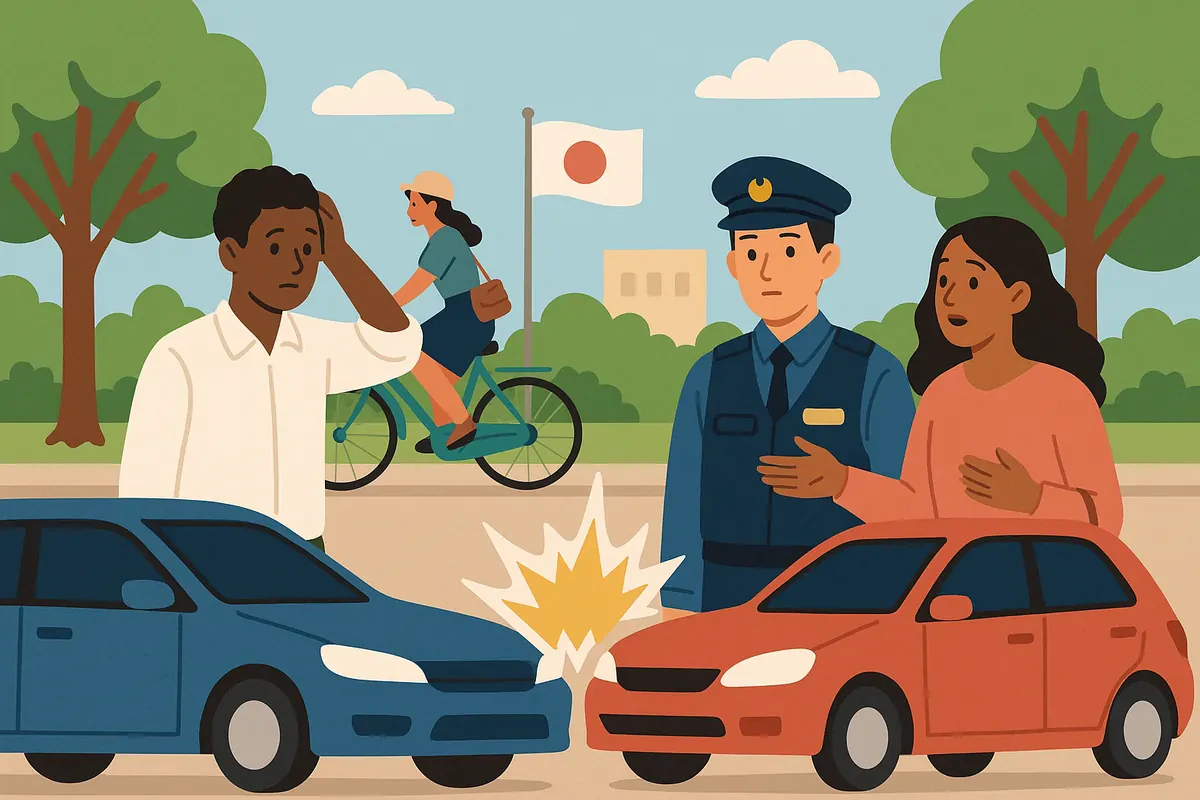
TL;DR. Call 110 (police) and 119 (ambulance) even for "minor" crashes — skipping this is a crime under 道交法 第72条. Always insist the report is filed as 人身事故 (personal injury) if anything hurts, because switching later is painful. Use your Japanese health insurance with a 第三者行為傷害届 — never pay full self-pay (自由診療), which burns through the 自賠責 1.2 million-yen injury cap in days. Never sign 示談 (settlement) before 症状固定. Information current as of May 2026.
The National Police Agency's 令和7年中の交通事故統計 recorded 2,547 traffic fatalities in 2025 — 116 fewer than the prior year, the lowest postwar figure, but still roughly seven deaths a day. Foreign residents are over-represented in two failure modes we see at LO-PAL: people who accept "just 物損" (property-only) at the scene and lose injury compensation, and people who pay cash at the hospital because nobody told them health insurance is allowed. This guide walks you through the Japanese system the way we wish someone had walked us through it.
1. What to do in the first 30 minutes
Japan's Road Traffic Act Article 72 (道路交通法 第72条) creates three non-negotiable scene duties for any driver — and "driver" includes cyclists in most contexts: stop immediately, render aid to the injured, and report to police. Failing to do these is a separate crime from the accident itself; 救護義務違反 (failure to render aid, i.e., hit-and-run) can mean up to 10 years' imprisonment.
Phone numbers and what to say in Japanese, even with broken pronunciation:
| Step | Number | Scripted phrase | Source |
|---|---|---|---|
| Ambulance (injuries) | 119 | 「きゅうきゅうです。こうつうじこです。ばしょは〇〇です。けがにんがいます。」 | FDMA 119 guide |
| Police | 110 | 「こうつうじこです。ばしょは〇〇です。」 | National Police Agency |
| Move vehicles to safe shoulder | — | Hazard lights, triangle reflector | 道交法 第72条 |
| Exchange info | — | Name, address, license, plate, insurer, policy number | 道交法 第72条 |
| Photograph scene | — | Skid marks, signals, damage, plates, witnesses | — |
Do not negotiate at the scene. Do not accept cash. Do not let the other driver talk you out of calling police "to keep it simple" — that conversation is the single most expensive sentence a foreign resident can agree to in Japan.
2. 人身事故 vs 物損事故 — why this single tick-box decides your life for 18 months
When the responding officer files the report, they classify it as either 物損事故 (property damage only) or 人身事故 (personal injury). The category is not a formality. 人身事故 triggers a 実況見分調書 (detailed scene reconstruction), which becomes the evidentiary backbone of every later claim — insurance, criminal, and civil. 物損 produces a short 物件事故報告書 that insurers and courts treat as thin.
If you say "I'm fine" at the scene and pain appears the next day — extremely common with whiplash (むち打ち) — you must return to the police with a 診断書 (medical certificate) from a doctor and request 人身切替 (reclassification). Police can refuse if too much time has passed or if causation looks weak. We have seen the window close inside 10 days.
Foreign-specific traps: police interviews are Japanese-only, statements are signed in Japanese, and 過失割合 (fault percentage) is shaped here. Under 民法 第722条第2項, 過失相殺 reduces your payout by your fault percentage. A "I think it was my fault" muttered to a kind officer in stumbling Japanese can cost you millions of yen later. Bring a Japanese-speaking friend, your insurer's accident line, or wait for an interpreter.
3. 自賠責 vs 任意保険 — the two-tier system foreigners always misread
Japan runs a two-layer auto insurance system, and conflating them is the single most common mistake we see.
| Layer | Name | Mandatory? | Covers | Limit | Source |
|---|---|---|---|---|---|
| 1 | 自賠責保険 (CALI) | Yes — by 自賠法 | Bodily injury only | Death 30M / Permanent disability up to 40M / Injury 1.2M | MLIT 自賠責限度額 |
| 2 | 任意保険 (voluntary) | No (but ~88% buy it) | Property, excess injury, your own car, your own medical | Per policy (usually unlimited bodily injury) | 損保協会 |
The legal scaffolding sits in 自動車損害賠償保障法 (自賠法): Article 3 imposes strict liability on the 運行供用者 (the person operating the vehicle for their own benefit), and Article 13 sets the limits above. Driving without CALI is up to 1 year imprisonment, 500,000 yen fine, and 6 demerit points — and 自賠責 covers nothing for property damage. Hit a parked Lexus with only 自賠責 and you pay the repair yourself.
For taxis, Uber, and rentals, CALI is automatically attached. For your own car or 50cc moped, you sign up at the dealer or konbini. For 任意保険, foreign residents with English support should look at Sony損保, Mitsui Direct, and e-design損保 — all three handle English-speaking customers and online quotes, with rates that often beat agency channels. CALI's official English overview is at MLIT — Compulsory Automobile Liability Insurance.
Bicycles are not covered by 自賠責 but generate the same civil liability under 民法 第709条. Thirty-five prefectures now mandate 自転車保険 (typically bundled as 個人賠償責任保険) — Toyama's mandate begins October 2026. A child cyclist in Kobe famously caused a 95-million-yen judgment in 2013; that case is why this is now mandatory almost everywhere.
LO-PAL tip. Before your annual renewal, ask whether 弁護士費用特約 (legal expense rider) is on your policy. It typically costs 1,500–3,000 yen/year and pays up to 3 million yen of attorney fees when you are the victim. Most foreign residents have it and don't know.
4. Medical treatment — use 健康保険 + 第三者行為傷害届 (not self-pay)
This is the section that saves the most money. Hospitals sometimes tell foreign patients "traffic accidents are 自由診療" (full self-pay). That is a misunderstanding — a longstanding 1968 MHLW notice (昭和43年保発第106号) confirms 健康保険 may be used for third-party injuries, and 協会けんぽ, 健保組合, and 国保 all accept this.
The mechanism is the 第三者行為傷害届 (Notification of Injury by a Third Party). You submit it to your insurer; they then pay your 70% portion, and later recover from the at-fault driver's insurer under their right of subrogation (代位求償).
| Item | Detail | Source |
|---|---|---|
| 協会けんぽ 第三者行為傷害届 | Form, instructions, sample | 協会けんぽ |
| 協会けんぽ 交通事故給付の流れ | End-to-end procedure | 協会けんぽ benefit page |
| 健保連 交通事故 | Same logic for 組合健保 | 健保連 |
| 損保協会 健保利用の解説 | Why 健保 beats 自由診療 | 損保協会 |
Why this matters numerically: 自賠責 caps injury at 1.2 million yen total — that includes treatment, lost wages, and pain-and-suffering. 自由診療 hospital billing typically runs 2–3× the 健保 fee schedule, so a fractured wrist with PT can torch the 1.2M cap in 4–6 weeks. With 健保, you preserve cap headroom for the parts that compound (慰謝料, 休業損害).
Voluntary-insurance compensation tables published by 損保協会 use 4,300 yen/day for 入通院慰謝料 and 6,100 yen/day for 休業損害 as baselines, but court (弁護士) standards using 赤い本 are typically 2–3× higher — another reason 弁護士費用特約 pays for itself.
LO-PAL can help. If you're stuck between a hospital saying "自由診療" and an insurance company saying "wait," we can walk you through the 第三者行為傷害届 paperwork and translate the form for your 区役所 or 協会けんぽ branch. Start at https://lo-pal.app.
5. If you're hit by an uninsured car or in a hit-and-run — 政府保障事業
About 4% of vehicles on Japanese roads are 無保険 (CALI lapsed). For hit-and-runs and uninsured-driver collisions, the government runs a backstop called 政府保障事業 (Government Guarantee System) under 自賠法 第72条. It pays the same limits as 自賠責 (death 30M, permanent disability up to 40M, injury 1.2M), funded by a slice of every CALI premium.
| Item | Detail | Source |
|---|---|---|
| Scheme overview | MLIT — eligibility, process | MLIT 政府保障事業 |
| Operational handling | GIROJ administers claims | GIROJ |
| Permanent disability grading | Survey system for 後遺障害 | GIROJ 損害調査 |
| Filing deadline | 3 years from the date of damage | 自賠法 第75条 |
You file at any non-life insurance company counter (損保会社の窓口) — they accept on behalf of the government. Bring the police accident certificate (交通事故証明書), 診断書, treatment receipts, and your bank account info. The three-year clock is shorter than the civil tort statute, so do not stall.
6. Settlement (示談), 症状固定, and 後遺障害 — don't sign too early
After your treatment, the insurance adjuster will eventually send a 示談書 (settlement agreement). Signing it terminates the claim. The cardinal rule: do not sign before 症状固定 — the medically-determined point at which further improvement is unlikely (typically 3–6 months for soft-tissue, longer for fractures or TBI).
Why this matters: 後遺障害 (permanent residual disability) compensation is only assessed after 症状固定. Grades 14 to 1 (lightest to heaviest) generate fixed 慰謝料 amounts plus loss-of-earning-capacity multipliers; even a Grade 14 (whiplash with persistent symptoms) can mean an additional 750,000–1,100,000 yen at insurance-company standards, and roughly double at court standards. GIROJ's 損害調査 office grades these claims independently of the carrier.
The civil statute of limitations is governed by 民法 第724条の2: 5 years for personal injury, 3 years for property damage, counted from the date you knew of the damage and the responsible party (typically the accident date). Do not let an adjuster suggest "we should wrap this up quickly" override your medical timeline.
7. Statute of limitations, visa myths, and the foreign-license trap
The most common foreign-resident fear we hear is "will this cancel my visa?" For a normal at-fault accident — no. Immigration's grounds for status revocation under 入管法 第22条の4 do not include garden-variety negligence. The cases that do cascade into immigration trouble are: drunk driving (酒気帯び/酒酔い運転), hit-and-run (ひき逃げ/救護義務違反), and fatal accidents leading to imprisonment without suspension (実刑). For background on which offenses actually risk status, see our visa threats guide.
The trap that does bite foreign residents is the 1-year IDP / translated-license cap. Per NPA's foreign-license guidance, an International Driving Permit or a translated home-country license is valid in Japan only for one year from your date of entry — not from issue date. Drive on day 366 and you are 無免許運転 (unlicensed driving): 3 years' imprisonment or 500,000-yen fine, plus a near-automatic visa problem. Convert to a Japanese license via 外免切替 before then — see our 外免切替 guide and driving license overview.
8. Pattern we see at LO-PAL + FAQ
Pattern (composite). A foreign cyclist was sideswiped by a turning sedan at a 23区 intersection. At the 交番 the officer said "no visible injury — let's call it 物損" and the rider, dazed and embarrassed, agreed. The next morning her neck and shoulder were locked. She came to us in tears, convinced her tourist visa for an upcoming family visit would be cancelled. We did three things: walked her to an orthopedic clinic for a 診断書, returned with her to the same police station to request 人身切替 (granted on day 4), and filed a 第三者行為傷害届 with 協会けんぽ so treatment ran on health insurance. We told her not to sign anything for six months. At 症状固定 she received a Grade 14 後遺障害 assessment; final 示談 closed at roughly 2.4M yen. Visa: untouched.
If you are reading this with a fresh police report in hand and you don't know what to do next, that is exactly the moment to talk to us at https://lo-pal.app. We are not a law firm, but we can sit with you through the forms, the translations, and the calls.
FAQ
Q1. The other driver wants to settle in cash at the scene. Should I?
No. Article 72 of the Road Traffic Act requires you to report to police. Cash settlements at the scene void your insurance claim and may be illegal.
Q2. Will I lose my visa over a normal fender-bender?
No. Only serious cases — drunk driving, hit-and-run, fatal accidents resulting in non-suspended prison terms — cascade into immigration risk.
Q3. The hospital says "traffic accidents are 自由診療." Is that true?
No. You can use health insurance with a 第三者行為傷害届. See 協会けんぽ.
Q4. The driver who hit me had no insurance and ran. What now?
File with 政府保障事業 within 3 years at any 損保 counter. Limits mirror 自賠責.
Q5. How long do I have to bring a civil claim?
5 years for personal injury, 3 years for property damage, from the date you knew (民法724条の2).
Q6. The adjuster is pressuring me to sign now. Should I?
No. Wait until 症状固定 and a 後遺障害 grading. Check whether you have 弁護士費用特約.
Q7. I was on a bicycle. Does any of this apply?
Yes. Civil liability under 民法709条 applies, and 35 prefectures now mandate cyclist liability insurance.
Q8. My IDP expires soon. What if I have an accident after?
You become 無免許 — a separate crime that does affect visa status. Convert via 外免切替 first.
Disclaimer. This article is general information current as of May 2026, not legal, insurance, or medical advice. LO-PAL is not a law firm, insurance broker, or medical institution. Statutes (自賠法・道交法・民法・健康保険法) and case law evolve; insurance terms vary by carrier and policy. If you are seriously injured, suspected of fault, or facing a fatal accident, consult a qualified lawyer (e.g., via 法テラス or 日弁連) before signing a 示談書 or 同意書. Visa consequences attach only to serious offenses (drunk driving, hit-and-run, fatal accidents) — not to ordinary negligence claims. For broader medical-system context, see our parent guide on the Japanese medical system for foreigners; for related reading, see health insurance, Okinawa car accidents, travel safety, and mental health.
Written by

Founder, LO-PAL
Former Medical Coordinator for Foreign Patients (Ministry of Health programme) and legal affairs professional. Built LO-PAL from firsthand experience navigating life abroad.
Written with partial AI assistance
Read full bio →