
Resident Tax in Japan: The Surprise That Hits Foreigners in June
Resident tax (住民税) is a flat 10% of your previous year's income, charged from June. This guide explains how it's calculated, the January 1 rule, special vs ordinary collection, and what happens when you quit or leave Japan.
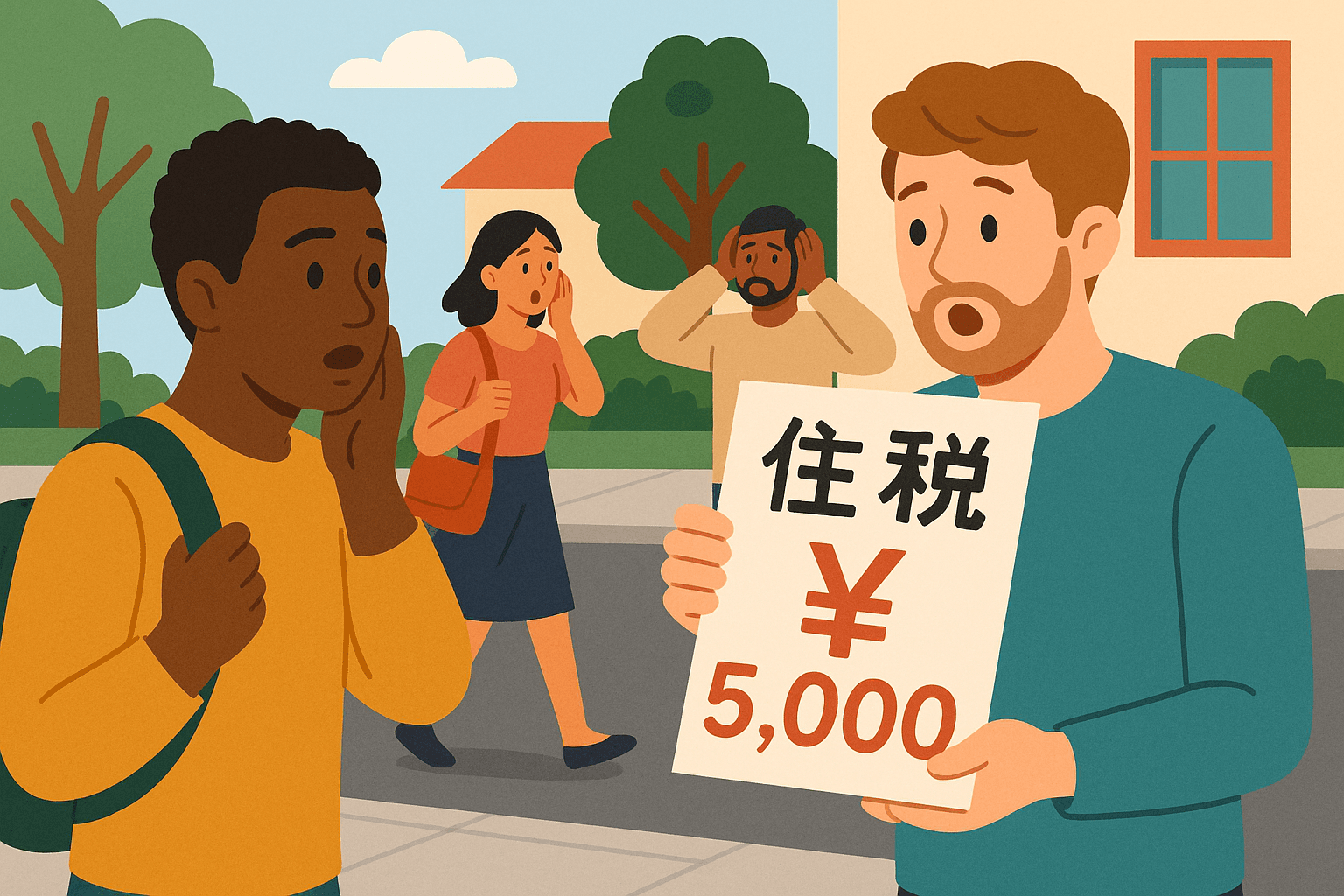
Fast answer: Resident tax (住民税 / juuminzei) is a flat 10% of your previous year's taxable income, charged by the municipality where you were registered on January 1. It appears on your payslip starting June — roughly 6–18 months after you started earning. If you leave Japan, the bill follows you.
Key dates: January 1 (assessment date), June (notice arrives + payments start), March 15 (deadline to report income if no employer files for you).
Information current as of March 2026 based on the Ministry of Internal Affairs and Communications, PwC Japan tax summaries, and official municipal tax guidance from Shinjuku, Shibuya, and other Tokyo wards.
Resident tax is the tax that surprises almost every foreign worker in Japan. Your first payslip has no resident tax line. Your second, third, fourth — same. Then June comes, and suddenly 10% of your income is being deducted each month. Nobody told you it was coming because everyone in the system assumed you already knew.
This guide explains the mechanics: how it's calculated, when it's charged, how to pay it, and what happens when you quit, move, or leave Japan.
How resident tax works: the basics
Resident tax consists of two parts:
| Component | Rate | Split |
|---|---|---|
| Income-based (所得割) | 10% of taxable income | 6% municipal (市区町村民税) + 4% prefectural (道府県民税) |
| Per capita (均等割) | ¥5,000/year | ¥3,000 municipal + ¥1,000 prefectural + ¥1,000 forest environment tax |
The ¥1,000 forest environment tax (森林環境税) was introduced in FY2024, replacing the earthquake reconstruction surcharge that ran from FY2014–FY2023. The total per-capita amount stayed at ¥5,000.
"Taxable income" means after deductions
Resident tax is calculated on your taxable income — not your gross salary. Your gross salary minus the employment income deduction, social insurance premiums, basic deduction, and any other deductions (dependents, insurance premiums, etc.) gives your taxable income. Then 10% of that is your income-based resident tax.
Example: Gross salary ¥5,000,000 → Employment income deduction ¥1,440,000 → Social insurance ~¥750,000 → Basic deduction ¥430,000 (for resident tax) → Taxable income ≈ ¥2,380,000 → Resident tax income-based portion ≈ ¥238,000/year (about ¥19,800/month).
The January 1 rule: who pays, and to which city
Resident tax is assessed by the municipality where you had a registered address (住民登録) on January 1 of the current year, based on your income from the previous calendar year (January 1 – December 31).
This creates several situations that catch foreigners off guard:
| Scenario | Result |
|---|---|
| You arrived in Japan in April 2025 | No resident tax until June 2026 (based on Apr–Dec 2025 income) |
| You move from Shinjuku to Osaka on March 1, 2026 | You pay 2026 resident tax to Shinjuku (where you were on Jan 1) |
| You leave Japan on December 28, 2025 (deregister) | No 2026 resident tax (you had no address on Jan 1, 2026) |
| You leave Japan on January 5, 2026 (deregister) | You owe 2026 resident tax to the city where you were registered on Jan 1 |
Critical point for departing residents: If you were registered on January 1 and leave before the June notice, you need to either prepay or appoint a tax agent (納税管理人). Otherwise, the bill arrives at an empty apartment.
When and how you pay: special collection vs ordinary collection
Special collection (特別徴収) — if you're employed
Your employer withholds resident tax from your paycheck in 12 monthly installments from June through May. The municipality sends a 住民税決定通知書 (resident tax determination notice) to your employer in May/June, which shows your tax for the upcoming year.
You should receive a copy of this notice (or your employer should show you the amount). This is also the document where you can verify your furusato nozei deduction.
Note: The June installment is often slightly larger than July–May because the annual amount doesn't divide evenly by 12. This is normal.
Ordinary collection (普通徴収) — if you're self-employed or between jobs
The municipality sends a bill directly to your address in June. You pay in 4 installments:
| Installment | Due date (typical) |
|---|---|
| 1st | End of June |
| 2nd | End of August |
| 3rd | End of October |
| 4th | End of January (next year) |
You can also pay the full amount at once using the 1st installment slip. Payment methods: bank, convenience store (if the amount allows), or increasingly, credit card or smartphone payment apps (PayPay, LINE Pay) depending on the municipality.
What happens when you quit your job
When you leave a company, the remaining resident tax switches from special to ordinary collection — but the timing matters:
| When you resign | What happens |
|---|---|
| January – May | Employer deducts all remaining months (Jan–May) from your final paycheck in one lump sum (一括徴収). This is mandatory. |
| June – December | Remaining months switch to ordinary collection. You'll receive bill slips at home. (You can also request lump-sum deduction from final pay.) |
If you start a new job quickly, your new employer can take over special collection — but you need to ask them to submit the transfer paperwork (特別徴収届出書) to the municipality.
Non-taxable thresholds: when you DON'T pay
Resident tax has exemption thresholds for low-income earners. These vary slightly by municipality, but the general pattern:
- Per-capita levy (均等割) exempt: If your total income is ¥450,000 or less (single, no dependents). With dependents, the threshold increases.
- Income-based portion (所得割) exempt: If your total income is ¥450,000 or less (single, no dependents). Again, dependents raise the threshold.
- Both exempt: If you had no income in the previous year (newly arrived, etc.)
These thresholds mean that part-time workers earning under roughly ¥1,000,000/year in salary may owe zero or minimal resident tax. The exact threshold depends on your municipality — check your city's website or ask at the tax counter.
Resident tax vs income tax: the differences that matter
| Income Tax (所得税) | Resident Tax (住民税) | |
|---|---|---|
| Collected by | National government (NTA) | Municipal + prefectural government |
| Rate | Progressive: 5%–45% | Flat: 10% |
| Based on | Current year income (estimated monthly) | Previous year income (calculated after year-end) |
| Timing | Withheld monthly from first paycheck | Starts June of the following year |
| Year-end settlement | Year-end adjustment or kakutei shinkoku | Automatically recalculated based on final income |
| Basic deduction (2025) | ¥580,000–¥950,000 (graduated) | ¥430,000 (fixed, unchanged in 2025) |
Important: The 2025 tax reform raised the income tax basic deduction (from ¥480,000 to ¥580,000+). But the resident tax basic deduction stayed at ¥430,000. They are different deductions with different amounts. This catches people who read about the "basic deduction increase" and assume it applies to both taxes.
How to read your resident tax notice (住民税決定通知書)
In June, you'll receive (or your employer will give you) a narrow, multi-fold document. Key items to find:
- 課税標準額 (kazei hyoujun gaku): Your taxable income base
- 所得割額 (shotokuwari gaku): Income-based tax amount
- 均等割額 (kintouwari gaku): Per-capita tax amount (should be ¥5,000)
- 税額控除 (zeigaku koujo): Tax credits applied (furusato nozei appears here)
- 差引年税額 (sashihiki nenzei gaku): Your total annual resident tax
- 月割額 (tsukiwari gaku): Monthly deduction amounts (June–May)
If you used furusato nozei, check the 税額控除 line — the donation amount minus ¥2,000 should appear there. If it doesn't, your one-stop exception may have failed. See: Furusato Nozei Mistakes →
FAQ
I just arrived in Japan. Do I owe resident tax?
Not until June of the year after you start earning. If you arrive in 2025 and start working, your first resident tax is charged from June 2026.
Can I pay resident tax by credit card?
Increasingly, yes. Many municipalities now accept credit card payment through their website or through smartphone apps. Check your municipality's tax page. Note: credit card fees may apply (typically ~0.8% of the payment amount).
I'm leaving Japan. How do I settle my resident tax?
See our detailed guide: How to appoint a tax agent before the June notice →
My resident tax seems wrong. What do I do?
Contact your municipality's tax division (税務課) with your determination notice. Common errors: dependents not applied, furusato nozei not reflected, or income from a previous employer not reported correctly.
Related Articles
- Japan Money & Tax Guide for Foreigners (2026)
- Kakutei Shinkoku 2026: Tax Return Guide
- Furusato Nozei: Avoid 3 Costly Mistakes
- Shinjuku Tax Agent Before June Notice
Need More Help? Ask on LO-PAL
Resident tax notices, exemption applications, and municipal tax offices all operate in Japanese. If you need help reading your tax notice, calling your municipality, or figuring out what you owe after quitting, LO-PAL can match you with a local helper who knows the process.
この記事のライター

LO-PAL 創業者
厚生労働省支援の外国人患者受入れ医療コーディネーター、法務の専門家。自らの海外生活経験と医療現場での知見をもとにLO-PALを設立。
※ 一部AIを使用して執筆しています
詳しいプロフィール →