Hurt at Work in Japan? Claim Rosai Even If Your Boss Says No
Hurt at work in Japan? A fast Rosai playbook for foreigners when the company delays, refuses forms, or tells you to use health insurance.
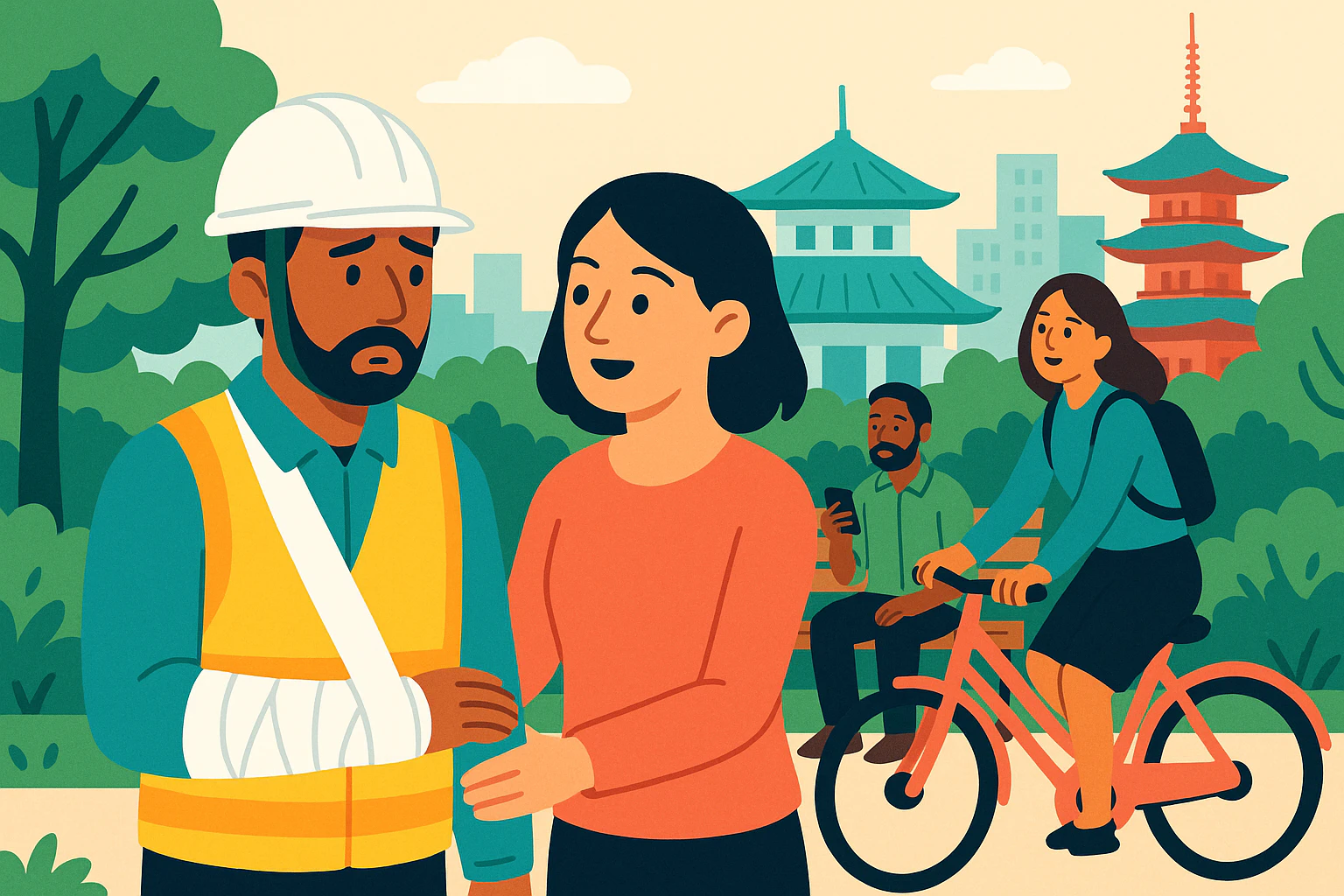
Fast answer: If you were hurt at work or on a qualifying commute in Japan, do not let the company push you into ordinary health insurance. Rosai claims go through the Labour Standards Inspection Office, and you can still file even if your employer refuses to sign.
Key deadlines: many reimbursement and wage-loss claims run on a 2-year clock, so start now. If you already paid a clinic, keep every receipt.
Where to go: a Rosai-designated hospital, your local Labour Standards Inspection Office, and the official multilingual labour hotlines.
Bottom line: get treated first, document everything, then self-file with the correct Rosai form if the company stalls.
Information current as of March 2026 based on materials from Japan's Ministry of Health, Labour and Welfare (MHLW), the official Rosai forms page, and official labour hotline pages. This is practical general information for foreign workers in Japan, not individual legal advice.
If you are searching for workers compensation Japan after an accident, the system you need is Rosai (workers' accident compensation insurance). In Japan, your boss does not get the final say on whether your injury is work-related. That decision belongs to the Labour Standards Inspection Office.
MHLW's foreign-worker guidance says Rosai applies regardless of nationality, and it covers part-time, temporary, dispatched workers, and foreign students who are allowed to work part-time. Just as importantly, ordinary health insurance is not the correct system for injuries caused by work or qualifying commuting.
I care about this topic because I once worked below minimum wage in the UK simply because I did not know my rights. Later, after returning to Japan, I worked with foreign patients in Osaka and also built services for foreigners trying to navigate Japanese systems. The real problem is often not a lack of rules. It is a lack of access.
Does your injury count as work-related or commuting-related?
More cases qualify than many foreign workers think, but not every accident will count. Start by sorting your case into one of these two buckets.
- Usually work-related: you were injured while doing your job, during overtime, while following a supervisor's instruction, inside the workplace, on a business trip, or because of a work-caused illness.
- Usually commuting-related: you were injured on a reasonable route between home and work, between one workplace and another if you have multiple jobs, or between assignment housing and home in qualifying cases.
- Watch detours carefully: a private detour can break commuting coverage. But MHLW's guide explains that small daily-life deviations, such as buying everyday necessities, may still be treated as commuting once you return to the normal route.
- Status usually does not block you: foreign nationality, part-time status, dispatch work, and permitted student baito do not remove Rosai coverage.
If you are unsure, do not let the company decide for you. A borderline case should still be taken to the Labour Standards Inspection Office, because Rosai questions are decided there, not by HR.
What to do in the first 24 hours if your boss says use health insurance
The first day matters because stories change fast, receipts get lost, and companies sometimes try to turn a Rosai case into an ordinary clinic visit.
- Get treatment immediately. If possible, use the official Rosai-designated hospital search. If you cannot, go to the nearest clinic or emergency room. In urgent cases, treatment comes first.
- Tell the hospital it is a work or commuting accident. This is important because MHLW says ordinary health insurance is not applicable for industrial accidents.
- If you already paid with health insurance, do not panic. Rosai can still reimburse treatment you paid first at a non-designated medical facility if the claim is approved. Keep every receipt, prescription slip, and transport record.
- Save proof before the facts get softened. Take photos. Write down the time, place, machine, task, route, witness names, supervisor instructions, and pain symptoms. Keep LINE messages, emails, shift schedules, route tickets, IC card history, taxi receipts, and hospital papers.
- Report it in writing today. Email or message is better than only telling someone verbally. Say when it happened, where it happened, and that you want Rosai processing.
- If you cannot work tomorrow, get that recorded. Ask the doctor to note that you are unable to work and from what date. That matters for wage-loss benefits.
Useful Japanese for the hospital or labour office
- 仕事中にけがをしました。労災で受診したいです。 (Shigotochuu ni kega o shimashita. Rosai de jushin shitai desu.) — I was injured at work. I want treatment under Rosai.
- 健康保険ではなく、労災でお願いします。 (Kenkou hoken dewa naku, rosai de onegaishimasu.) — Please process this under workers' compensation, not health insurance.
- 会社が労災の証明をしてくれません。自分で申請したいです。 (Kaisha ga rosai no shoumei o shite kuremasen. Jibun de shinsei shitai desu.) — My company will not provide Rosai certification. I want to file myself.
If you are stuck after business hours, the official Labour Standards Advice Hotline has English support at 0120-531-401, and multilingual support is available in 13 languages on different schedules. During office hours, use MHLW's foreign worker consultation page to find the right contact line.
If the paperwork or Japanese phone calls are blocking you, ask on LO-PAL.
How to file a Rosai claim without employer cooperation
This is the part many workers get wrong: employer cooperation is helpful, but it is not the legal switch that makes a claim possible.
- Download the correct form from MHLW's Rosai forms page. Use Form No. 5 for treatment at a Rosai-designated hospital after a work accident, Form No. 16-3 for a qualifying commuting injury, Form No. 7 for reimbursement after you paid first for a work accident, Form No. 16-5 for reimbursement after you paid first for a commuting injury, Form No. 8 for work-accident wage-loss benefits, and Form No. 16-6 for commuting-injury wage-loss benefits.
- Fill your side of the form and attach proof. Add your contract, payslips, shift table, doctor papers, photos, witness names, route information, and screenshots showing the employer delayed or refused cooperation.
- Submit it anyway. MHLW's foreign-worker guide and MHLW's own FAQ both say claims can be accepted without employer certification if the company refuses to cooperate. The Labour Standards Inspection Office can investigate directly.
- Do not stop if the company says you are too part-time or not enrolled. MHLW says workers can still receive Rosai even if the employer failed enrollment, and part-time workers remain covered if they are workers under the system.
- If the accident is old, check the time limit instead of guessing. MHLW says you can still claim after leaving the company, and even if the company no longer exists, but old cases fail once the relevant limitation period has expired.
- Tell the inspector if the company is hiding the accident. MHLW's labour-law guide says that when workers are absent because of occupational accidents, the employer must report the case to the Labour Standards Inspection Office, and hiding serious occupational accidents is unlawful.
Practically, that means you should keep your own file and not let the company control the only copy. Submit in person if possible and ask what extra documents the inspector wants. If you mail documents, use a trackable method and keep copies of everything.
Experience box — individual experiences vary. One foreign resident wrote on Reddit:
"As I could only speak day-to-day Japanese, I could not talk to the insurance company, and it was done by my company and agency company."
Another worker posted on Reddit:
"I'm only a part-time worker... money is a bit tight."
That combination of language dependence and part-time confusion shows why self-kept evidence matters. Even if your Japanese is limited, the Rosai system does not disappear just because your employer is the only one comfortable with the paperwork.
What Rosai can pay: hospital bills, transport, and wage replacement
Rosai is not only about medical treatment. For many injured workers, the urgent issue is staying afloat while they cannot work.
| Item | Amount/count | Source/as-of date |
|---|---|---|
| Treatment at a Rosai-designated hospital | ¥0 at point of care in principle | MHLW foreign-worker Rosai guide, Feb. 2025; designated-hospital page accessed Mar. 2026 |
| Treatment paid first at a non-designated facility | Reimbursable later if approved | MHLW foreign-worker Rosai guide, Feb. 2025 |
| Transport for treatment | Payable in qualifying cases | MHLW foreign-worker Rosai guide and forms page, accessed Mar. 2026 |
| Wage replacement | From day 4, 80% of the basic daily amount | MHLW foreign-worker Rosai guide, Feb. 2025 |
| Breakdown of day-4 payment | 60% insurance benefit + 20% special allowance | MHLW foreign-worker Rosai guide, Feb. 2025 |
| Employer duty for first 3 missed days of an occupational injury | 60% of average wages per day | MHLW foreign-worker Rosai guide, Feb. 2025 |
| Deadline for medical/transport reimbursement claims | 2 years from the day after payment | MHLW foreign-worker Rosai guide, Feb. 2025 |
| Deadline for absence-from-work benefits | 2 years from each unpaid day | MHLW foreign-worker Rosai guide, Feb. 2025 |
Hospital and clinic costs: At a Rosai-designated hospital or clinic, treatment is generally free at the point of care. If you used another medical facility, paid first because it was an emergency, or were wrongly told to use health insurance, reimbursement is still possible with the correct form and receipts.
Transport: MHLW's guide says transport needed for treatment can also be covered in qualifying cases. Keep train tickets, IC history, taxi receipts, and a short note explaining why that route or transport was necessary.
Wage replacement: If you cannot work because of treatment and receive no wages, Rosai pays 80% of the basic daily amount from day 4. For an occupational injury, the first 3 missed days are generally the employer's responsibility at 60% of average wages per day.
Longer-term support: If symptoms stabilize but disabilities remain, disability benefits may apply. If the case becomes very serious or fatal, there are surviving family and funeral benefits as well. For most urgent foreign-worker cases, though, the biggest early wins are correct medical processing, wage-loss forms, and not missing the 2-year deadlines.
Job protection: MHLW's labour-law guide explains that, for occupational accidents, dismissal is generally prohibited during the leave period and for 30 days after it ends. If your employer also cuts wages, stops scheduling you, or pressures you to resign, treat that as a separate labour problem and document it too.
Related Articles
- How to Recover Unpaid Wages in Japan Before 3 Years Run Out
- Horenso Meaning in Japan: How to Report Problems at Work
- Best Translation Apps for Foreign Residents in Japan
Need More Help? Ask on LO-PAL
Don't risk taking time off work only to be sent home because of a missing form or a language barrier. On LO-PAL, you can ask a question or book a local Japanese helper to call the labour office with you, help translate the Rosai paperwork, or accompany you to the hospital or Labour Standards Inspection Office so you can get it done right the first time.
Written by

Founder, LO-PAL
Former Medical Coordinator for Foreign Patients (Ministry of Health programme) and legal affairs professional. Built LO-PAL from firsthand experience navigating life abroad.
Written with partial AI assistance
Read full bio →