Kanagawa Foreign Family Guide 2026: Daycare, Schools & Belonging
Yokohama and Kawasaki both reported zero daycare waitlists on 1 April 2025, and free child healthcare is expanding to age 18 in 2026 across Kanagawa.
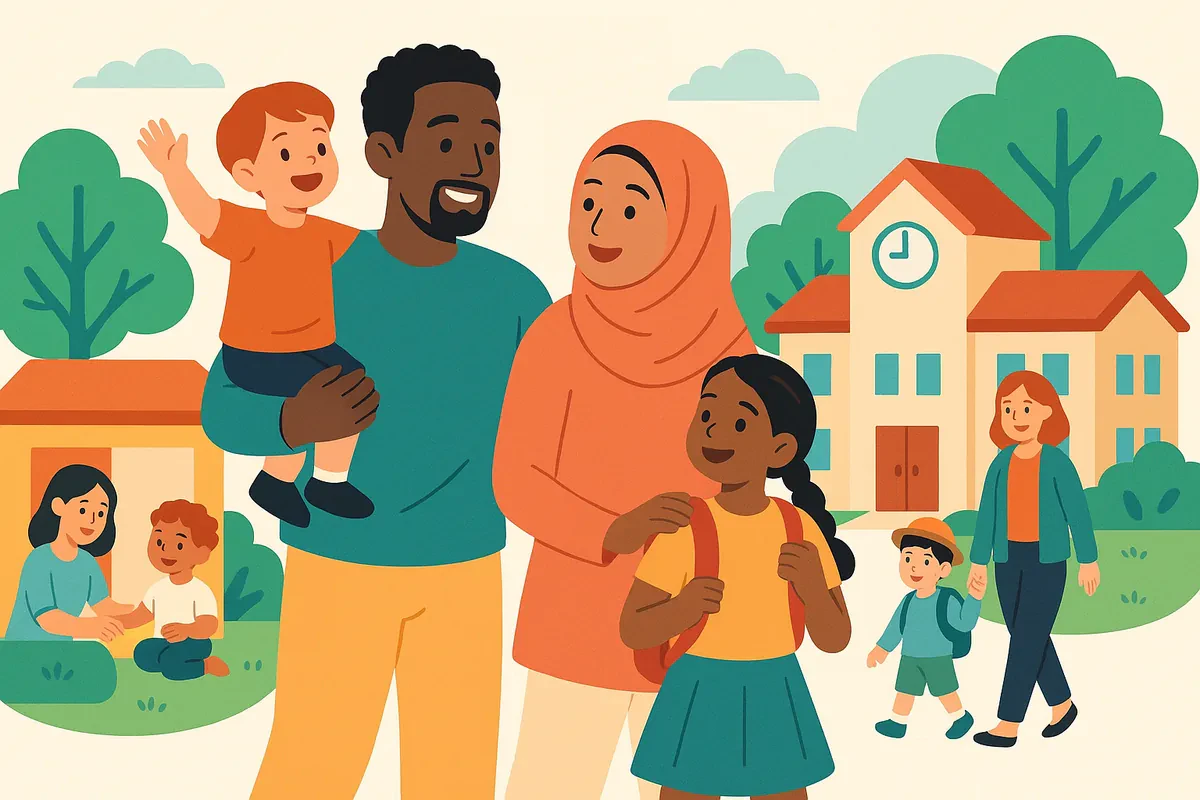
Whether you moved to Yokohama for your spouse's job, followed a work transfer into Kawasaki, or are already here and now wrestling with daycare waitlists and school enrollment, you have landed in one of the most family-workable corners of Japan for foreign residents. That is not an accident. Kanagawa has been absorbing foreign families for more than 160 years — ever since Yokohama's port opened in 1859 and a foreign settlement grew into what is today one of the largest Chinatowns in East Asia — and the prefecture has built real machinery for raising children who did not start out speaking Japanese.
This guide walks through the practical parts of family life in Yokohama and Kawasaki: finding a family-sized apartment and what rent to budget, getting a nursery place, enrolling children in public school with Japanese-language support, paying (or not paying) for births and doctor visits, and the visa road from Dependent status toward permanent residence. It uses Kanagawa's own published figures and its own consultation desks.
2026 quick takeaway: Kanagawa was home to 29,532 residents on the Dependent (family) visa as of 30 June 2025, the 4th-largest such community in Japan. Both Yokohama and Kawasaki reported zero children on the official daycare waitlist as of 1 April 2025 (Kawasaki likewise), and free child healthcare is expanding toward age 18 in 2026.
For the big-picture case for the prefecture as a whole, see our guide to living in Kanagawa and the national ranking of the best prefectures for foreigners. This article zooms in on family life.
Who lives in Kanagawa with a family
Kanagawa is Japan's 4th-largest prefecture for foreign residents, with 317,353 foreign residents as of 31 December 2025, and families are a large part of that picture. On the immigration ministry's detailed mid-year count, Kanagawa held 29,532 people on the Dependent visa and 98,625 permanent residents as of 30 June 2025 — the 4th- and 3rd-largest totals in the country. Many of the working parents behind those families hold the Engineer / Specialist in Humanities / International Services status, of which Kanagawa had 41,737, the 3rd-most of any prefecture, reflecting how many white-collar households commute from here into the wider Tokyo economy.
Most of those families cluster in the three big cities, and here it helps to switch to the residents'-registry count, which is a different statistical system and date from the immigration figures above. By that measure, Yokohama had 137,812 foreign residents as of 31 December 2025, Kawasaki had 61,597, and Sagamihara had 22,138 as of 1 January 2026. In other words, roughly two of every three foreign residents in the prefecture live in Yokohama or Kawasaki.
The welcome to foreign families here is not new, and that history has practical value. Yokohama's Chinatown in Naka Ward is one of the largest in East Asia, with roughly 620 shops packed into about 0.2 square kilometres; Naka Ward alone counted 10,265 Chinese residents on the residents' registry at the end of 2025. In Kawasaki's Sakuramoto district, a Korean community that formed around the wartime coastal factories built one of Japan's model 多文化共生 (multicultural coexistence) neighbourhoods, anchored by the city's Fureai-kan community centre, opened in 1988 specifically to bring foreign and Japanese residents together. And Yokohama's Tsurumi Ward is home to a century-old Okinawan and South American community along the Nakadori shopping street. For a foreign parent, that heritage shows up as multilingual signage, established community groups, and ward offices that are genuinely used to serving non-Japanese families.
Family-friendly wards and what rent to budget
Rent is usually the biggest line in a family budget, and Kanagawa sits below central Tokyo while staying firmly inside the commuter belt. For a family-sized 2LDK or 3K, SUUMO's Kanagawa rent averages (as of 10 July 2026) in Yokohama run from about ¥103,000 in Totsuka Ward and ¥104,000 in Aoba Ward, through mid-range family wards such as Tsuzuki (¥118,000) and Kohoku (¥133,000), up to ¥174,000 in Naka Ward and ¥190,000 in Nishi Ward near the Minato Mirai waterfront. Families often choose Aoba, Tsuzuki, and Kohoku for their newer housing, parks, and schools, while Tsurumi (¥125,000) offers the established South American community mentioned above.
In Kawasaki, the same source puts family-sized rent from about ¥107,000 in Asao Ward and ¥110,000 in Miyamae, up to ¥146,000 in Nakahara Ward, home to the fast-growing Musashi-Kosugi high-rise district that is popular with dual-income families. Kawasaki Ward itself — the industrial, most international part of the city — averages about ¥128,000 for a 2LDK. If cheap access into Tokyo is the priority, the Tama and Asao wards on the western edge are the most affordable. Renting as a foreign family still brings the usual hurdles of guarantor companies, key money, and Japanese-only screening, so it is worth reading our guide to rental contracts, guarantors and fees and the five reasons foreigners get rejected first. If a landlord hesitates, you can ask a local resident for a gut check on LO-PAL before you commit to anything.
Whichever ward you choose, your first stop after moving in is the ward office, where you register your address, get your My Number card, and enroll in health insurance. Our My Number card walkthrough for Yokohama and the wider first-year settling-in checklist cover the sequence. That address registration is also what unlocks daycare and school applications, so do it early.
Daycare: both big cities hit zero waitlists in 2025
Here is the headline that matters most to working parents. Both of Kanagawa's biggest cities reported zero children on the official daycare waitlist in spring 2025. Yokohama hit zero waitlisted children as of 1 April 2025 — its first zero in 12 years — with an 82.8% placement rate against 74,477 licensed slots. Kawasaki reported zero for the 5th year running, with an 85.6% placement rate.
One honest caveat keeps this realistic: "zero waitlist" (待機児童ゼロ) is a narrow legal definition, and it is not the same as "every family got the nursery they wanted." Kawasaki still had 1,265 "reserved" children (保留児童) as of 1 April 2025 — families who did not get a place at the specific nursery they applied to, often because they only listed one or two nearby options. So the practical advice is to apply early, list several nurseries, and understand the municipal points system that decides who gets in. Our guides to daycare for foreign parents and the step-by-step hoikuen application process walk through the documents and the enrollment calendar. If you are not working full-time, the new national "any child can attend" (こども誰でも通園) scheme is also worth checking, since it lets you use nursery hours regardless of employment.
Public schools, Japanese-language support, and halal lunch
Public schools in Japan accept foreign children regardless of visa status, and Kanagawa has built genuine infrastructure for kids who arrive with little or no Japanese. Yokohama runs a set of Japanese-language support hubs called "Himawari," where a newly arrived or returning child gets about one month of intensive beginner Japanese and school-life orientation, three days a week, across three locations (Himawari, Tsurumi Himawari and Tsuzuki Himawari), before or alongside starting at their local school. At the prefectural level, Kanagawa maintains a dedicated program of guidance and support for children with foreign roots. If you are new to how Japanese elementary and junior-high enrollment works, start with our public school guide for foreign parents and the school-supplies checklist, because the list of things you must buy for the first day is longer and more specific than most newcomers expect.
School lunch (給食) is another common worry, especially for Muslim families, because most Japanese public schools serve a single set menu that can contain pork or alcohol-based seasonings. Yokohama has been working on this, and we cover the practical options in our dedicated piece on halal-friendly school lunch in Yokohama. More broadly, if halal access shapes where you want to live, our roundup of Muslim-friendly areas of Japan covers mosques, halal shops, and prayer space. Menus and accommodations vary by school and change over time, so always confirm the current specifics with your child's school and the local board of education.
Birth costs, the child allowance, and children's medical subsidies
Kanagawa is a genuinely affordable place to have and raise children, thanks to national benefits layered on top of generous local subsidies. Nationally, the childbirth lump sum and the moves toward free delivery are covered in our guides to having a baby in Japan as a foreigner and the 2026 push to make childbirth free. Once your child is born and registered at the ward office, you can claim the monthly child allowance (児童手当), which foreign families receive on the same terms as Japanese families.
Children's medical subsidies are where Kanagawa really stands out — and they are being expanded right now, so the details matter and differ by city. In Yokohama, outpatient and inpatient care is currently free through the end of junior high, and the city is extending free child healthcare up to age 18 from June 2026 — the first among Kanagawa's designated cities to do so. Kawasaki currently covers children through junior high and is expanding to the high-school-age bracket from September 2026, while scrapping the ¥500 per-visit co-pay that currently applies from 4th grade up. Sagamihara already subsidises care through the high-school-age bracket. Because these schemes are set by each municipality and are changing during 2026, confirm the current age limit and any co-pays with your own city's child-medical desk.
Health insurance, medical interpreters, and multilingual help desks
Every resident in Japan must enroll in health insurance, which covers about 70% of most medical costs and is what makes the children's subsidy above actually usable. If you or your spouse work for a company, your children are normally added as dependents on employees' health insurance at no extra premium; otherwise the household joins National Health Insurance at the ward office. Our guides explain how health insurance works for foreigners, how to add family members as dependents, and how to navigate the Japanese medical system when a child gets sick.
Language at the hospital is a real barrier, and Kanagawa has one of Japan's strongest answers to it. MIC Kanagawa, a certified non-profit, dispatches trained medical interpreters in 13 languages to 72 partner medical institutions, at ¥3,000 (plus tax) per two-hour dispatch — a fraction of the true cost, subsidised by the prefecture. For everyday questions about schools, benefits, or visas, the prefecture-backed Multilingual Support Center Kanagawa answers in 11 languages on 045-316-2770, Yokohama runs a multicultural one-stop consultation center in 12 languages on 045-222-1209, and Kawasaki's international association (KIAN) offers consultations in 11 languages on 044-455-8811. On LO-PAL you can also ask a local Japanese resident your specific question — the kind of thing that is hard to look up, like which pediatrician near you actually speaks English.
Family visas and the road to permanent residence
The visa side of family life in Kanagawa runs through the Yokohama District Branch of the Tokyo Regional Immigration Bureau, in Kanazawa Ward, which covers all of Kanagawa, plus a Kawasaki branch office in Asao Ward. If you are married to a Japanese national, the Spouse of Japanese National status is the usual route — see our spouse visa guide — and marriage is also one of the faster paths to permanent residence, explained in our guide to permanent residence through marriage. If you are on a work visa and bringing a spouse and children on Dependent status — the layer of families behind Kanagawa's 29,532 dependent-status residents — permanent residence eventually becomes the goal for many households; the income and residence requirements are covered in our PR income requirement guide. Immigration rules change, so always confirm the current criteria and document lists with the bureau or a qualified professional before you file.
FAQ: raising a foreign family in Kanagawa
Is it hard to get a daycare place in Yokohama or Kawasaki?
By the official measure, no. Both cities reported zero children on the waitlist as of 1 April 2025. But "zero waitlist" is a narrow definition: Kawasaki still had 1,265 "reserved" children who did not get their preferred nursery. Apply early, list several options, and learn the municipal points system.
Is children's healthcare really free in Kanagawa?
Largely, yes, though it is set by each city. Yokohama is currently free through junior high and expands free care to age 18 from June 2026; Kawasaki expands to the high-school-age bracket from September 2026; and Sagamihara already covers the high-school-age bracket. You need a resident registration and public health insurance, and the rules change, so confirm with your city hall.
Can my child attend public school without speaking Japanese?
Yes. Public schools accept foreign children regardless of visa status, and Yokohama runs "Himawari" support hubs at three locations that give newly arrived children about a month of intensive beginner Japanese and school-life orientation, three days a week, before or alongside their local school.
Which visa lets me bring my family to Kanagawa?
A worker on most mid- and long-term visas can bring a spouse and children on Dependent (家族滞在) status; Kanagawa had 29,532 dependent-status residents as of 30 June 2025. If you are married to a Japanese national, you would instead hold a spouse status. Everything is filed at the Yokohama immigration branch that covers Kanagawa, and rules change, so verify the current requirements before applying.
Where can we get help in our own language?
For hospital visits, MIC Kanagawa dispatches medical interpreters in 13 languages to 72 partner institutions. For everyday questions, the Multilingual Support Center Kanagawa (11 languages), the Yokohama one-stop center (12 languages), and Kawasaki's KIAN (11 languages) all take walk-ins and phone calls.
Written by

Founder, LO-PAL
Former Medical Coordinator for Foreign Patients (Ministry of Health programme) and legal affairs professional. Built LO-PAL from firsthand experience navigating life abroad.
Written with partial AI assistance
Read full bio →