DV on a Spouse Visa in Japan: How to Leave Safely (2026)
You are protected by Japanese law, even without citizenship. This guide gives you the helplines, the protection-order path, and the step-by-step route to keep your visa after you leave.
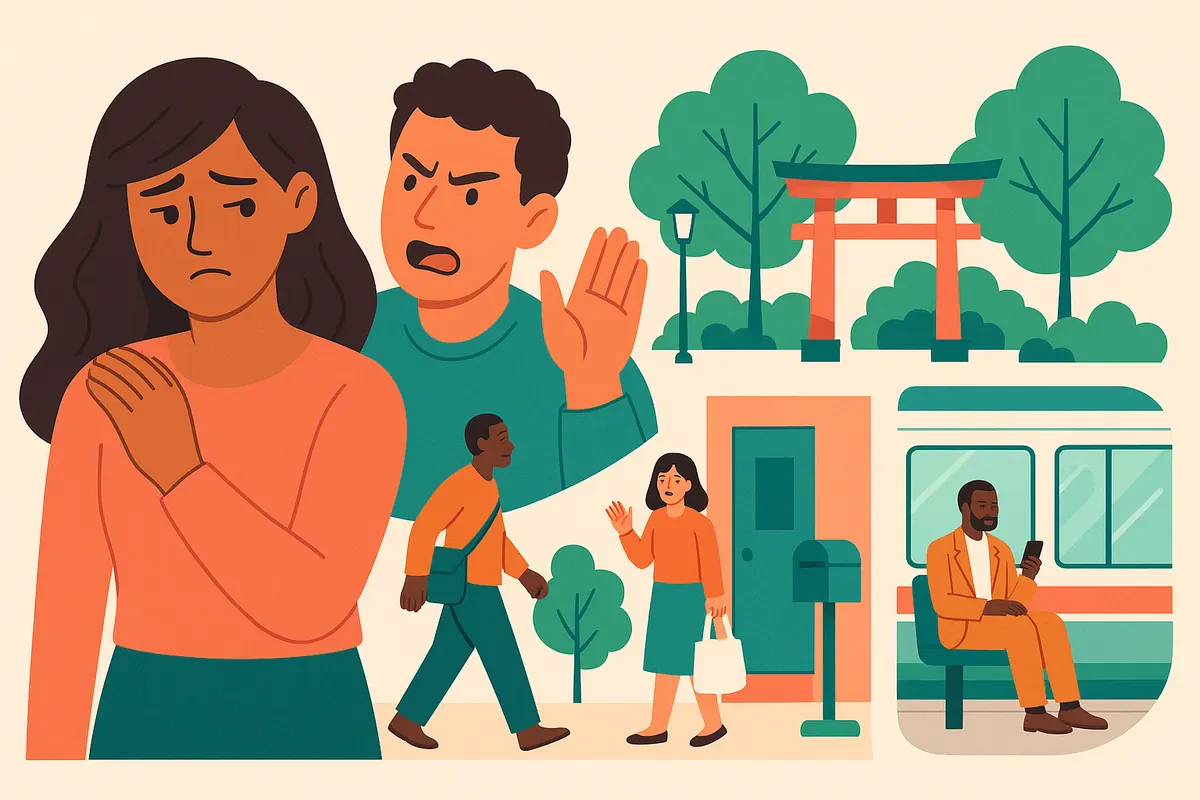
If you are in danger right now, call 110 (police). You do not need to speak fluent Japanese — say your address and "tasukete" (help).
- DV相談プラス — 0120-279-889 — 24/7, free, anonymous, chat and email also available in 10 languages (English, Chinese, Korean, Tagalog, Portuguese, Spanish, Thai, Vietnamese, Indonesian, Nepali). Language page.
- DV Navi — #8008 ("haya-oh-oh-ya") — connects you to your nearest public Spousal Violence Counseling and Support Center.
- Police consultation — #9110 — non-emergency, multilingual help, advice before things escalate.
- Grab if you can: passport, residence card, health insurance card, phone + charger, bank card, medicine, children's documents. If they are hidden or taken, leave anyway — they can all be reissued.
TL;DR.
- Your spouse cannot cancel your visa. Only Immigration can — and Immigration treats fleeing DV as a legitimate reason.
- Public shelters (一時保護) and helplines are free. Lease, language, and money are not barriers.
- After leaving, you have a real path to keep status: notify Immigration within 14 days of divorce/separation and apply to change to 定住者 (Long-Term Resident).
- From April 1, 2026, revised Civil Code Art. 819(7) requires sole custody where DV or abuse is present.
Information current as of May 2026.
1. If You Are in Immediate Danger Right Now
Call 110. Police in Japan respond to DV calls, including from foreign residents. Your immigration status is not their priority — your safety is. If you cannot speak Japanese, the dispatcher can connect a three-way interpreter line; you can also say "English please" and stay on the line.
If the abuser has taken your residence card or passport, this is a crime (theft / unlawful retention) and does not affect your legal status. Report it to police, get a 受理番号 (case number), then request reissue: residence card at the nearest Immigration office, passport at your embassy. Your status remains valid while reissue is processed.
If you cannot leave the home yet, save these numbers in your phone under an innocuous name, memorize one (0120-279-889), and keep a small "go-bag" hidden — at a neighbour's, a locker, a friend's. The Cabinet Office English DV page has the full multilingual contact list.
2. You Are Protected by Japanese Law — Even Without Citizenship
The Act on the Prevention of Spousal Violence and the Protection of Victims (DV防止法) protects every victim in Japan regardless of nationality, visa type, or whether you are legally married, in a de-facto relationship, or already separated. See the statute on e-Gov and the Cabinet Office's 2024 amendment explainer.
The April 2024 revision expanded protection in four ways that matter for you:
- Protection orders now last 1 year (previously 6 months).
- Threats against your freedom, reputation, or property now qualify — not only physical violence.
- Penalties for breaching a protection order increased to up to 2 years' imprisonment or a 2 million yen fine.
- Mental and economic abuse are explicitly recognised in interpretation guidance.
Myth to kill now: "My spouse will cancel my visa." Impossible. Only the Immigration Services Agency can revoke a status of residence, under Immigration Act §22-4. Fleeing DV is recognised by Immigration as a legitimate reason (正当な理由) against the "6 months of inactivity as a spouse" trigger in §22-4(1)(vii).
3. Spousal Violence Counseling and Support Centers (配偶者暴力相談支援センター)
Every prefecture operates at least one 配偶者暴力相談支援センター. They coordinate counselling, safety planning, shelter intake, court paperwork support, and liaison with Immigration on your behalf. They are free and confidential. Find yours via the national directory, or dial #8008 from anywhere in Japan to be routed to the nearest one.
| Helpline | Number | Hours | Languages | Source |
|---|---|---|---|---|
| Police emergency | 110 | 24/7 | JP + interpreter line | gov-online |
| Police consultation | #9110 | Daytime, varies | Multilingual support | gov-online |
| DV相談プラス | 0120-279-889 | 24/7 | 10 languages + chat/email | soudanplus.jp |
| DV Navi (#8008) | #8008 | Center hours | Routes to local center | DV Navi |
| TELL Japan Lifeline | 03-5774-0992 | Daily 9:00–23:00 | English | TELL |
| Houterasu multilingual | 0570-078377 | Mon-Fri 9-17 | 10 languages | Houterasu |
4. Getting a Protection Order (保護命令)
A 保護命令 is a court order from the District Court (地方裁判所). After the 2024 reform there are six types, and the standard duration is one year. See the Cabinet Office overview at gender.go.jp/policy/no_violence/e-vaw/law/12.
- 接近禁止命令 — abuser may not approach you.
- 退去命令 — abuser must leave the shared residence (you stay; up to 2 months).
- 電話等禁止命令 — no phone, email, SMS, social media contact.
- 子への接近禁止命令 — protection extends to children.
- 親族等への接近禁止命令 — extends to relatives and supporters.
- 位置情報取得禁止命令 — new in 2024; bans GPS tracking and stalker-ware.
You file at the District Court covering either your address or the abuser's. The support center will help you prepare the petition; 法テラス can fund a lawyer if you qualify. Breach is criminal: up to 2 years' imprisonment or 2 million yen fine.
Free, confidential bilingual help from LO-PAL. If reading legal Japanese feels impossible right now, message us at lo-pal.app. We do not charge, we do not judge, and we will help you find the right Japanese professional — lawyer, support center, or shelter — in your language.
5. Shelters & Temporary Protection (一時保護)
Public 一時保護 (temporary protective custody) at a 婦人相談所 / women's consultation center is free — including meals, bedding, and basic clothing. Average stay is two weeks while the center helps you plan next steps. NGO shelters (often run via NWSNET member organisations) provide longer stays and trauma-informed support. TELL Japan can coordinate English-speaking placement.
You do not need to be on the lease. You do not need cash. You do not need your spouse's consent. Children come with you. If you have pets, ask the intake worker — some shelters partner with animal foster networks.
6. Your Visa After Leaving: The 定住者 Path
This is the section abusers do not want you to read. The legal route is well-established.
| Your current status | If you leave / divorce | Realistic path | Source |
|---|---|---|---|
| 日本人の配偶者等 (Spouse of Japanese) | Status can be revoked after 6 months inactivity — but DV = legitimate reason | Change to 定住者 citing DV | ISA guideline |
| 永住者の配偶者等 (Spouse of PR) | Same as above | Change to 定住者 | ISA guideline |
| 永住者 (Permanent Resident) | Status unaffected by divorce | Keep PR | ISA §22-4 |
| 家族滞在 / 留学 / 技能実習 | Dependent path narrower | Case-by-case — humanitarian 定住者 possible | Cabinet Office |
| Any status, divorced/separated | 14-day notification required | File 配偶者に関する届出 | ISA notice |
The three-year-marriage requirement for 定住者 that you may have read on forums is the general rule. DV is a recognised special circumstance that overrides it (see the ISA change-of-status guideline above). Bring: protection-order copy or 配偶者暴力相談支援センター referral, police report, medical records if any, and the divorce/separation paperwork.
Pattern we see at LO-PAL
Composite based on patterns we see — not a real individual, all identifying details removed. A woman on a 日本人の配偶者等 visa was told repeatedly by her husband that her visa would be cancelled "the moment she walked out." With her local 配偶者暴力相談支援センター she filed for a 保護命令 — the 退去命令 type, so her husband left and she stayed in the apartment with her child. She notified Immigration of the separation within 14 days using the 配偶者に関する届出 form, then applied for 在留資格変更 to 定住者, citing DV as 正当な理由 with the protection order and center referral letter as evidence. Approval took roughly four months. She kept her status, her apartment, and her child.
7. Divorce, Custody & Children with Japanese Citizenship
Under Civil Code Art. 770, court-ordered divorce is available for violence ("malicious abandonment" and "grave reasons making continuation of marriage difficult" both cover DV). You do not need your spouse's signature; you can file at family court (家庭裁判所).
From April 1, 2026, revised Civil Code Art. 819(7) takes effect: where DV or child abuse is present, family courts must grant sole custody (単独親権) to the protective parent. The reform that introduced optional joint custody (共同親権) is genuinely new and interpretation is still developing — bring documentation, do not rely on assumption.
Critical warning on the Hague Convention. Japan is a party to the Hague Convention on International Child Abduction. Taking your child under 16 out of Japan without the other parent's consent or a court order is international child abduction — even if you are fleeing DV. The correct path: family court first, custody order, then travel. Embassies and 法テラス can advise.
8. Money, Housing, Free Legal Help & Long-Term Recovery
Lawyers. 法テラス (Japan Legal Support Center) offers free consultations and cost-deferred representation for low-income residents — including foreign residents. The multilingual line 0570-078377 covers ten languages.
Housing. After shelter, options include 母子生活支援施設 (mother-and-child livelihood support facilities — see overview), municipal 公営住宅 priority slots for DV survivors, and the national 住居確保給付金 housing benefit.
Address protection. File a 住民基本台帳事務における支援措置申出 at your new municipality. This blocks your 住民票 and 戸籍附票 from being disclosed to the abuser or their representatives. Renewable yearly. Do this the day you register your new address.
Welfare caveat. 生活保護 (livelihood protection) is applied to foreign residents only in five status categories: 永住者, 定住者, 特別永住者, 日本人の配偶者等, 永住者の配偶者等. If you hold a different status, lean on shelter + NGO + 法テラス until status is changed.
Eight Myths to Stop Believing Today
- "Divorce means I lose my visa." False — change to 定住者.
- "I need my spouse's permission to leave or divorce." False.
- "Police won't help foreigners." False — #9110 is multilingual.
- "Shelters cost money." False — public 一時保護 is free.
- "My spouse already cancelled my visa." Impossible — only Immigration can.
- "I'll never see my child again." 2026 reform mandates sole custody where DV exists.
- "I'll take my child home where it's safe." That triggers the Hague Convention — go to family court first.
- "I must have been married 3 years for 定住者." False — DV is a special circumstance.
Where to Go Next
If you are still in the relationship, your one action today is to save 0120-279-889 and message it on chat tonight when the home is quiet. If you have already left, your next action is the 14-day Immigration notification and an appointment with 法テラス. Related LO-PAL guides:
- Spouse Visa Japan: complete 2026 guide (parent article)
- Divorce in Japan for foreign spouses
- Preventing a forced/unilateral divorce (離婚不受理)
- Visa threats and abuse — your legal protections
- Free English-language counselling in Japan
- Mental-health resources for foreign residents
- Reporting discrimination and abuse of power
LO-PAL is here. Free. Confidential. Bilingual. Reach us at lo-pal.app. We will sit with you while you call the helpline, draft the Immigration notification, or find a lawyer who speaks your language. You do not have to do this alone, and you do not have to do it in Japanese.
Disclaimer. This article is general information, not legal, medical, or psychological advice. LO-PAL is not a law firm, medical provider, immigration agency, or police authority. Japanese law on DV, custody, and immigration is evolving — in particular, revised Civil Code joint-custody provisions take effect April 1, 2026, and interpretation is still developing. Always consult a licensed 弁護士 (lawyer) or 行政書士 (administrative scrivener), or contact 法テラス, before making visa or divorce decisions. If you are in immediate physical danger, call 110 now.
Written by

Founder, LO-PAL
Former Medical Coordinator for Foreign Patients (Ministry of Health programme) and legal affairs professional. Built LO-PAL from firsthand experience navigating life abroad.
Written with partial AI assistance
Read full bio →