Year-End Adjustment in Japan: The ¥50,000 Refund You're Leaving on the Table
Year-end adjustment (年末調整) is how most employees in Japan settle their income tax. Fill out 3–5 forms in November, attach insurance certificates, and your employer refunds the difference in December.
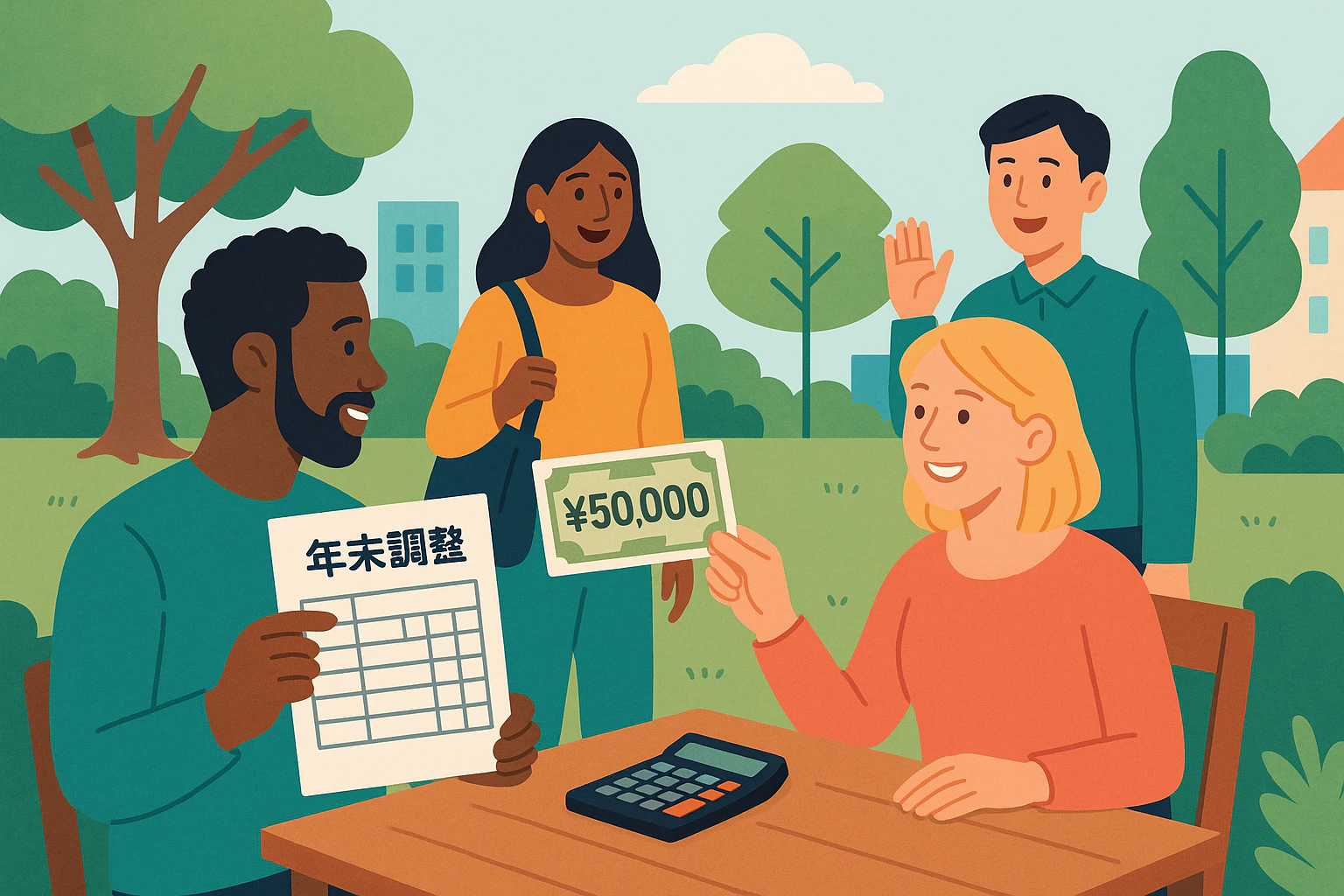
Fast answer: Year-end adjustment (年末調整 / nenmatsu chosei) is how most employees in Japan settle their income tax. Your employer recalculates your annual tax in November–December, and the difference shows up in your December or January paycheck — usually as a refund.
What you need to do: Fill out 3–5 forms (in Japanese) by mid-November. Attach insurance premium certificates. Submit to your employer.
If you miss it: You'll need to file a kakutei shinkoku (tax return) yourself in February–March.
Information current as of March 2026 based on the National Tax Agency year-end adjustment forms page, TaxMatch Japan, and the NTA basic deduction guidance (No.1199).
Every November, your company hands you a stack of Japanese forms. Your Japanese colleagues breeze through them. You stare at dense kanji, wondering if you should just ignore them. Don't. These forms determine whether you overpaid income tax this year — and year-end adjustment is how you get that money back.
What year-end adjustment is (and why it exists)
Throughout the year, your employer withholds income tax from each paycheck based on an estimate. This estimate uses a standard table and doesn't account for your actual deductions (insurance premiums, dependents, etc.). By December, the estimate is usually too high.
Year-end adjustment is your employer recalculating the exact income tax you owe, then refunding the difference (or, rarely, collecting a shortfall). Most employees receive a refund of ¥10,000–¥50,000.
Timeline: when things happen
| When | What happens |
|---|---|
| Early November | Employer distributes year-end adjustment forms |
| Mid-November | Deadline to submit completed forms (varies by company) |
| Late Nov – Dec | Employer calculates your actual tax |
| December paycheck | Refund (or additional charge) appears |
| January 31 | Employer issues your 源泉徴収票 (gensen choshuhyo) — your annual tax certificate |
The forms you need to fill out
There are up to 5 forms. All must be submitted in Japanese. Here's what each one is and how to fill it out:
Form 1: 扶養控除等(異動)申告書 — Dependent Deduction Declaration
Everyone must submit this, even if you have zero dependents. It determines your withholding rate (甲欄 vs 乙欄). Without it, you're taxed at the higher "Class B" rate all year.
What to fill in:
- Your name, address, My Number
- Spouse information (if applicable)
- Dependents (including overseas family — see below)
- Disability status, widow/widower status, student status
Form 2: 基礎控除申告書 + 配偶者控除等申告書 + 所得金額調整控除申告書
These three are on one sheet. Fill in the sections that apply to you:
- 基礎控除 (basic deduction): Estimate your total 2025 income. Based on your income level, your deduction is ¥580,000–¥950,000 (see the graduated table in our Money & Tax Guide).
- 配偶者控除 (spouse deduction): Only if your spouse's income is under the threshold. Enter your spouse's estimated income.
- 所得金額調整控除: Only if your salary exceeds ¥8.5M and you have a dependent child under 23 or a disabled family member.
Form 3: 保険料控除申告書 — Insurance Premium Deduction Declaration
This is where the money is. Attach certificates (控除証明書) from your insurance providers:
- 生命保険 (life insurance): Your insurer sends a certificate in October. Maximum deduction: ¥120,000 (combined for general life, care medical, and individual annuity).
- 地震保険 (earthquake insurance): Maximum deduction: ¥50,000.
- iDeCo: Full contribution is deductible. Attach the 小規模企業共済等掛金控除証明書 from your iDeCo provider.
- National Health Insurance (国民健康保険): If you paid NHI premiums (e.g., before employer enrollment), you can deduct them here. No certificate needed — just the total amount paid.
Form 4: 住宅借入金等特別控除申告書 — Housing Loan Deduction
Only from the 2nd year of your housing loan deduction onward. The first year must be claimed via kakutei shinkoku. The NTA sends you this form after your first-year filing.
Claiming overseas dependents (国外居住親族の扶養控除)
If you financially support family members abroad, you may be able to claim them as dependents — but the requirements tightened in 2023:
- The family member must earn less than ¥480,000/year (or ¥580,000 from 2025)
- For dependents aged 30–69 who are neither disabled nor students, you must prove you sent ¥380,000+ per year in remittances to that individual
- Documents needed: Proof of relationship (birth certificate, family register with Japanese translation) + proof of remittance (bank transfer records showing the recipient's name)
Submit these to your employer with your dependent deduction form. The deduction amount ranges from ¥380,000 to ¥630,000 per dependent, depending on age.
2025 income changes: what's new in this year's forms
Higher basic deduction
For 2025 income, the basic deduction on Form 2 is graduated by income level:
- Income ≤ ¥1.32M: ¥950,000 deduction
- Income ¥1.32M–¥3.36M: ¥880,000
- Income ¥3.36M–¥4.89M: ¥680,000
- Income ¥4.89M–¥6.55M: ¥630,000
- Income ¥6.55M–¥23.5M: ¥580,000
This is temporary for 2025–2026 income. From 2027, most people will use ¥580,000. Source: NTA No.1199.
New: 特定親族特別控除 (Specified Relative Special Deduction)
If you have a dependent aged 19–22 with income up to ¥850,000, you can claim up to ¥630,000 in deduction. This is a new graduated deduction replacing the old cliff-edge system. Declare this on your dependent deduction form.
When year-end adjustment is NOT enough (and you need kakutei shinkoku)
Year-end adjustment handles most deductions, but not all. You still need to file a tax return (確定申告) if:
- You want to claim medical expense deduction (医療費控除) — this cannot be done through year-end adjustment
- You're claiming the first-year housing loan deduction
- You had side income exceeding ¥200,000
- You worked for two or more employers during the year
- Your salary exceeded ¥20,000,000
- You used furusato nozei with more than 5 municipalities
- You left Japan mid-year
See our full guide: Kakutei Shinkoku 2026 →
Common mistakes foreigners make
| Mistake | Consequence | Fix |
|---|---|---|
| Not submitting the dependent form (Form 1) | Taxed at higher 乙欄 rate all year | Submit it even if you have no dependents |
| Ignoring the forms because they're in Japanese | Lose ¥10,000–¥50,000+ refund | Ask HR for help. Use our field-by-field guide above. |
| Not attaching insurance certificates | Insurance premium deduction not applied | Collect certificates from Oct; attach originals to Form 3 |
| Not claiming overseas dependents | Missing ¥380,000–¥630,000 deduction per person | Prepare relationship proof + remittance records before November |
| Forgetting iDeCo certificate | Full contribution not deducted | Certificate arrives Oct/Nov. Attach to Form 3 under 小規模企業共済. |
What to do if you missed year-end adjustment
If you didn't submit the forms (or submitted them late/incomplete), your employer can't redo the adjustment. Your options:
- File a kakutei shinkoku between February 16 and March 15 (or late — there's no penalty for refund-only filings)
- Use your gensen choshuhyo (issued by January 31) as the basis for your return
- Claim all the deductions you missed (insurance, dependents, etc.) on the tax return
Full e-Tax walkthrough → | Gensen choshuhyo missing? →
Related Articles
- Japan Money & Tax Guide for Foreigners (2026)
- Resident Tax in Japan Explained
- Kakutei Shinkoku 2026: Tax Return Guide
- Gensen Choshuhyo Missing? What to Do
Need More Help? Ask on LO-PAL
Year-end adjustment forms are all in Japanese, and your HR department may not be able to help in English. If you need someone to walk you through the forms, check your insurance certificates, or help you claim overseas dependents, LO-PAL can match you with a helper who knows the process.
Written by

Founder, LO-PAL
Former Medical Coordinator for Foreign Patients (Ministry of Health programme) and legal affairs professional. Built LO-PAL from firsthand experience navigating life abroad.
Written with partial AI assistance
Read full bio →